

Meanwhile, data from the Monetary Authority of Singapore (MAS) shows that the number of single-family offices there hassurgedto more than2,000fromless than a hundred in 2018.In the same year, Singapore’s Economic Development Board recorded annual business investment commitments totalingS$12.9billion.

Why did Dyson transfer£624m to Singapore but leave just£1 in the UK?
In 2025,JamesDyson,78,completed a sophisticated reorganization of assets through his family office, the Weybourne Group. According to the company’s incorporation documents, the group transferred at least£624 millionfrom its main UK entityto a Singaporean holding company, leaving the UK entity with a nominal£1of capital on its books.
This operation is a continuation of Dyson’s strategy of moving its commercial footprint eastward:
In2019, Dyson Group moved its global headquarters from the UK to Singapore;
The Singapore global headquarters at St. James Power Station opened in2022.Family business strategists analyzed the adjustment as part of ‘s “multi-year succession roadmap.“
Dyson is not alone in its choice;data shows thatmore than400multinational companies will set up or expand their regional headquarters in Singapore in2025alone, and global capital is systematically converging here.

Photo/James Dyson, Source: Union-Tribune, Censored

Singaporevs.the UK:4points of contrast inthe policy environment
The timing of the transfer of Dyson’s assets coincided with a historic turnaround in UK tax policy. The contrast in policy between the two places in four key areas explains the inevitability of the capital flows.
1. Tax Burden: UK Increases Across the Board vs Singapore Remains Competitive
InApril2025,the UKended its two-century old“non-resident“tax credit. Under the new rules, those who have lived in the country for 10 years or more may face up to40%inheritance tax ontheir global assets.
In contrast, Singapore offersa tax regime withzero capital gains tax and no estate duty.
Notably, Singaporewillreduce its corporate income tax rate from17%to15%fromJanuary 1,2026, further enhancing its tax competitiveness,according toinformation fromthe Ministry of Finance and the Inland Revenue Authority of Singapore (IRAS).
2. Approval Efficiency: Complicated Process in UK vs Efficient and Transparent Process in Singapore
Singapore hasshortened the approval time forfamily office tax exemption (13O/13Uscheme) applications toless than3 months. The post-Brexit regulatory environment in the UK has become more complex, with significant increases in corporate compliance costs.
3、International alignment: UK policy fluctuations vs Singapore’s proactive docking
Singapore wasone ofthe firstjurisdictionsin the world to implement the Organization for Economic Co-operation and Development‘s(OECD)15%low tax rate. The frequent post-Brexit adjustments to UK policy have created significant uncertainty in long-term business planning.
4. Talent Policy: Tightening Restrictions in the UK vs Positive Openness in Singapore
Singapore continues to attract international professionals through its flexible work visa policy. The UK, on the other hand, has tightened its work visa criteria, leading to more restrictions on the inflow of international talent.
As a direct result of the policy differences,the UK is projected to experiencea net loss of around16,500million-dollar millionairesin2025, according to thePrivate Wealth Migration Report2025.In contrast, the number of family offices in Singaporehassurged toover2,000over the same period.
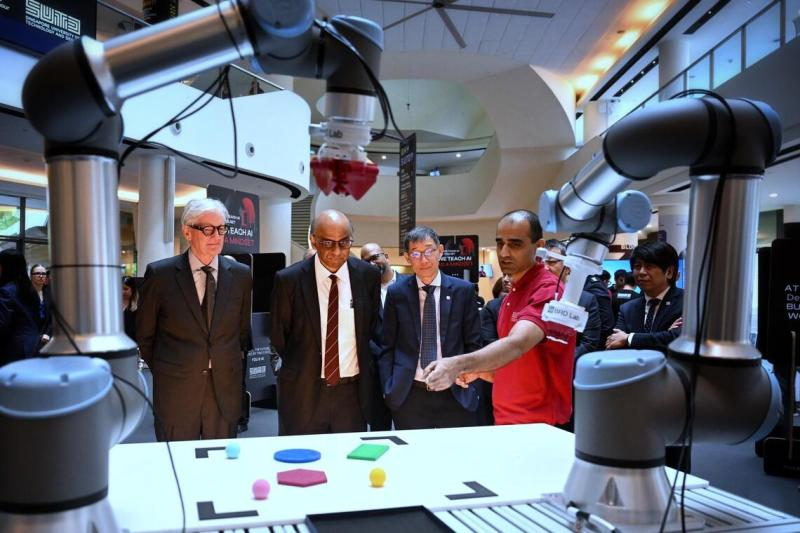
Photo/Shantamantours the facilitywithJames Dyson and others, Credit: Union-Tribune, Censored

Why Singapore?The Fortune 500 value these4advantagesmore than anything else
What the Dyson case reveals is the systemic advantages that multinationals consider when choosing Singapore. Fortune 500 companies in particular look for these four key aspects:
1. Strategic Location and Market Access: Crossroads of Global Shipping
Located at the eastern end of the Straits of Malacca, Singapore is a major shipping hub connecting the Pacific and Indian Oceans.25%of theworld’smaritime trade passes through here. Companies with regional headquarters in Singapore are able to cover and respond to the fast-growing Southeast Asian market more efficiently.
2. Perfect Laws and Intellectual Property Protection
Singapore has a well-developed legal system based on English common law and combined with local realities, and its intellectual property protection is among the best in the world. This environment has attracted a large number of high-tech enterprises, making Singapore’s R&D investment continue to grow and become an important innovation center in Asia.
3. Global Talent Pool
National University of Singapore (NUS) and Nanyang Technological University (NTU) are ranked among the top universities in the world, producing a large number of high-quality graduates every year. At the same time, Singapore’s flexible talent policy has enabled it to attract a large number of international professionals, providing a rich pool of talent for multinational companies.
4. Excellent Infrastructure and Digitalization
Singapore is home to Changi Airport, which has been rated the best in the world for many years, and a port that is a leader in efficiency. In terms of digitization, Singapore’s broadband speeds and coverage are among the highest in the world, providing businesses with an efficient operating environment.

Photo/Dyson’s international headquarters in Singapore, Credit: United Daily News

“ZF-wide“service model: efficient synergies for business facilitation
Singapore’s attractiveness goes far beyond the policy advantages on paper; its efficient governance system creates real economic value.
The Monetary Authority of Singapore (MAS)seeks to strike a balance between encouraging fintech innovation and maintaining systemic stabilityunder the “risk-based“principle. For example,MASis actively researching cutting-edge areas such as distributed ledger technology and asset tokenization, while developing related risk management guidelines.
The unique “ZF-wide“service modelsignificantly reduces the cost of doing business. The Economic Development Board (EDB) is able to coordinate withvarious departments such asthe Monetary Authority (MA), the Internal Revenue Service (IRAS), and the Accounting and Corporate Regulatory Authority (ACRA) to provide one-stop serviceswhen important businesses are considering investment. This highly synergistic model greatly enhances administrative efficiency.
Singapore’s Accounting and Corporate Regulatory Authority (ACRA) is also continuing to enhance its regulatory efficiency. According toACRA‘s plan, the agency is utilizing data analytics and artificial intelligence to enhance risk monitoring, aiming to achieve more accurate and efficient regulation.
The stability of the rule of law environment is a cornerstone of Singapore. The World Bank’s Doing Business report has ranked Singapore among the world’s top countries for many years. This rule of law environment has enabled Singapore to maintain a very high level of foreign direct investment (FDI) stock.

Pic/Dyson duster, Credit: United Daily News

The data bear out: investment commitments translate into high-quality growth
Several sets of data together validate the strength and effectiveness of Singapore as a global capital destination:
Singapore’s Economic Development Board (EDB) annual report shows that business investment commitments attracted for the year totaledS$12.9billion, and these investments are expected to create more than20,000professional jobs. Of particular note is thatmore than60%of these investmentswent to knowledge-intensive activities such as research and development and headquarters management.
Key industries formed a strong industrial cluster effect. In the semiconductor field, UMC investedUS$5 billionto expand its Singapore wafer fab. Singapore has formed a complete semiconductor ecosystem, gathering many of the world’s leading semiconductor companies.
The intensive presence of multinational companies has boosted economic resilience. Nearlyone-thirdof the world’s top technology, consumer and healthcare companies have their regional or global headquarters in Singapore. More than60%of the Fortune 500 companies have a significant presence here. This diversified corporate structure is an important pillar of Singapore’s economic stability.

Figure/Schematic, Source:Dyson

Synergies: The Dyson Case Reveals Strategic Logic
The Dyson case clearly reveals the multidimensional strategic considerations behind multinationals’ decisions.
The integration of business operations and wealth management can lead to significant efficiencies and synergies. The Dyson Group, which has its global headquarters in Singapore, has placed its family offices in the same jurisdiction so that corporate profit sharing, capital movements and family wealth management can be seamlessly integrated within a unified legal and tax framework. According to industry analysis, this structure can save large multinational groups significant costs in cross-border financial coordination.
Laying a reliable institutional foundation for intergenerational inheritance is critical. For founding families such as Dyson’s, the long-term management and safe transmission of wealth is a central concern. Singapore’s stable political environment and robust and predictable rule of law system provide a solid“infrastructure“for designing succession plans that span decades.
The optimization of global management structures directly enhances competitiveness. Dyson has“slimmed down“and simplifiedits global business structure by consolidating its assets and management functions, which were dispersed in the United Kingdom and the United States, into a single entity in Singapore.
This centralized management brings shorter decision paths and greater operational efficiency, helping companies respond faster to regional market changes.

Schematic diagram, source:Dyson
[Conclusion]
From Dyson’s£624million versus£1 to Singapore’s attraction ofS$12.9billionininvestmentin one year, the data reveals a clear logic to global capital flows. Companies are not choosing Singapore based on a single advantage, but a systemic competitiveness that combines its strategic location, legal environment, governance effectiveness and future prospects.
Singapore’s success lies in the fact that it offers much more than tax incentives; it offers a whole set ofsystemic solutionsfor “clear rules, predictable policies and efficient governance“.Against the backdrop of increased uncertainty in the global economy, this“institutional certainty premium“has become a scarce resource that is more valuable than short-term incentives.
In the face of future challenges, Singapore’s response strategy has demonstrated its ability to continue to evolve, maintaining its core institutional strengths while continuously and proactively investing in emerging areas such as the digital economy, green transformation and talent development.
This ability to stay true to its roots while embracing change is what has enabled Singapore to leapfrog from a regional hub to a strategic location for global capital and business.
*Reference sources: SingaporeEDB,MAS, MOF,IRAS,ACRA, United Morning Post,Dyson,Private Wealth Migration Report2025,World Bank Doing Business Report, OECD,,comprehensive news reports collated, reproduced with attribution, infringement and deletion of contact.
……
👇 Plus V enters Singapore’s largest outbound community 👇

Past Recommendations