

When you get Singapore Permanent Residency (PR) or formally join Singapore citizenship, and are ready to start a new chapter in your life, how to deal with the property, savings and other assets that you have left behind in the country becomes a realistic and thorny issue.
There are all sorts of claims circulating, but the truly legal, safe and officially recognized pathway has actuallybeen explicitly statedas early as2005.

I. What is officially recognized as“transfer of immigrant property“?
According to the Interim Measures for the Administration of Sales and Payment of Foreign Exchange in connection with the Transfer of Personal Property to Foreign Countries issued by the State Administration of Foreign Exchange,there is a clear definition of“transfer of immigrant property“.
It specifically refers tonatural persons who haveemigrated from Mainland China and obtained permanent residency (e.g. SingaporePR), or have acquired a foreign nationality (e.g. Singapore citizens).
There is akey time prerequisite forsuch transfers: they can only be made by liquidatingthe legal property they owned in Chinaprior to obtaining their immigration status, and then purchasing and remitting the foreign exchange.
Simply put, this policy provides you with a one-time opportunity tolegally transfer the assets you have legally accumulated in your home country during the“first half of your life“to your new place of living overseas in a compliant manner.
Alongside this is the“transfer of inherited property“, but that applies to foreign nationals or residents of Hong Kong, Macau and Taiwan who are inheriting from a domestic estate, which is different from the needs of the majority of immigrants.
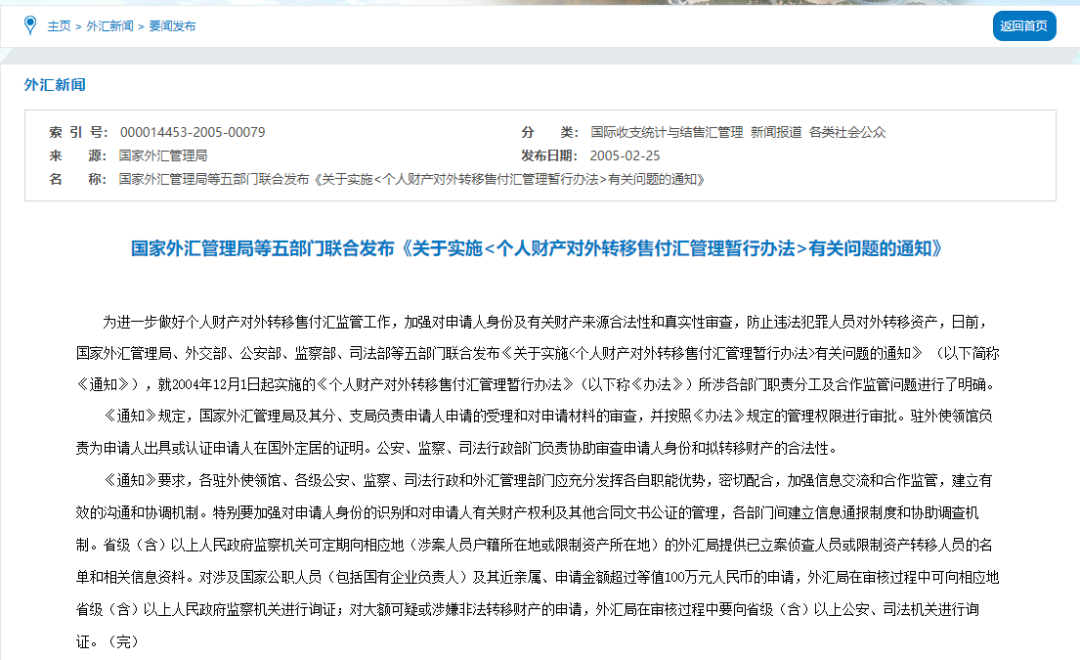
Infographic, source: Foreign Exchange Bureau

II. Who can apply? Are you eligible?
To apply for an immigrant property transfer, you must meet any of the following status requirements:
1. Migrated from Mainland China to a foreign country and obtained permanent residency in the country of current residence (e.g. SingaporePR).
2. Have emigrated from Mainland China to a foreign country and have acquired the nationality of that country of residence (e.g. Singaporean citizens).
This means that you arein principle eligible to apply, regardless of whether you hold a SingaporeGreen Card(PR) or have already renewed your Singapore passport.
A crucial step is the cancellation of domestic household registration.Official documents specify that applicants are required to providea certificate of cancellation of domestic household registrationissued by the public security authorities in the place of domicile prior to emigration.
For those who have joined a foreign country, this is a legal necessary procedure; for those who only hold permanent residence in a foreign country (PR), although the law does not directly stipulate that it is necessary to cancel the account for the right of permanent residence, the foreign exchange management department will ask for the proof in the practical operation of handling the transfer of assets.
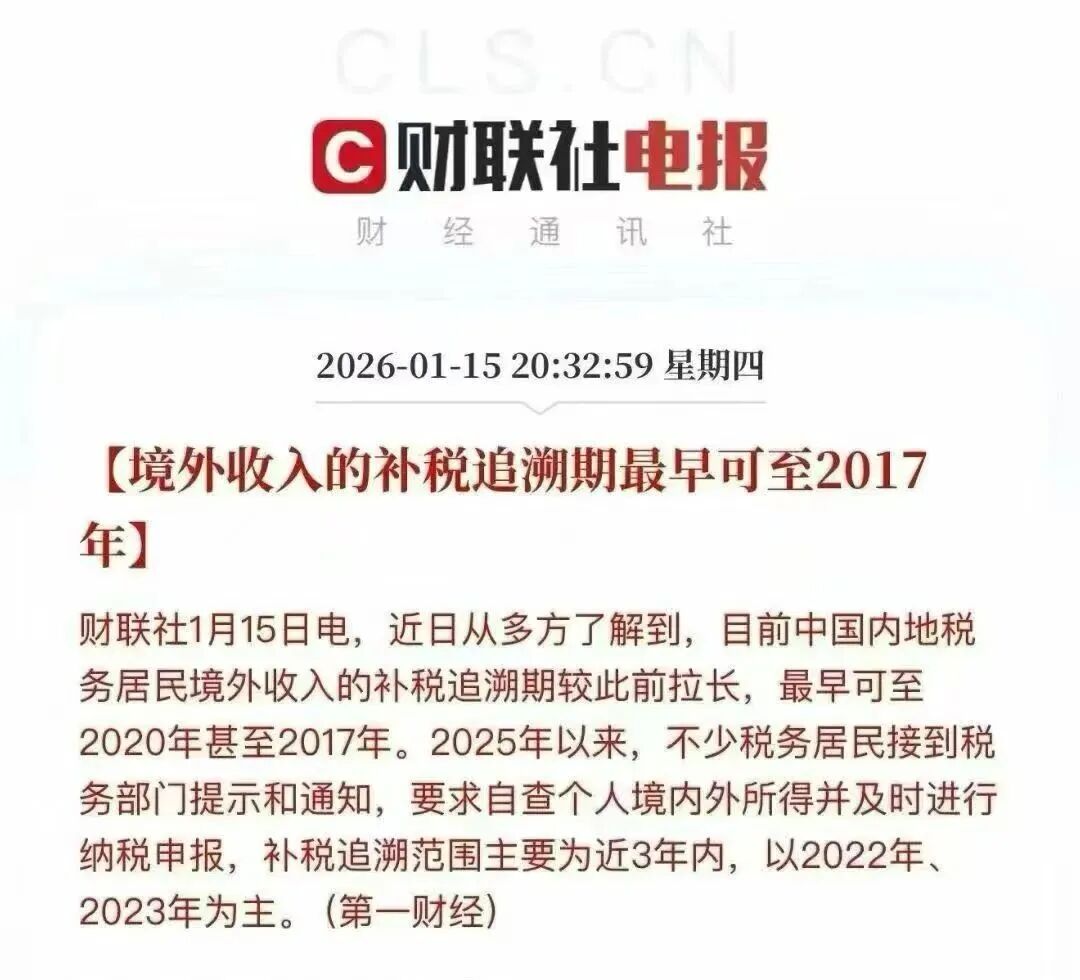
Press materials, source: Caixin, First Finance

III. Specific operation of the whole process: from application to the exit of funds
The whole process can be summarized as“one application, review and approval, remittance in steps“. The following are the core steps and key points:
Step 1: Submit all applications at once
You need tosubmit the applicationto thebranch/management department ofthe foreign exchange bureau in your original domicile.The key here is“one-time“, you must declare the total amount of all the property you plan to transfer at one time.
Step 2: Review and Approval
Amount cut-off point:Ifthe equivalent amount of the property applied for transfer isless than500,000 RMB, the branch office of the local foreign exchange bureau shall examine and process the application.
Thoseexceeding the equivalent value ofRMB500,000 (inclusive)are subject to preliminary examination by the branch office and then submitted to SAFE for final approval.
Step 3: Step-by-step remittance of funds (key rule)
This is the most important rule of operation:
For approved amountsbelow RMB200,000, a one-time remittance is allowed.
For thetransfer of immigrant propertyexceedingRMB 200,000 (inclusive), theprinciple of“one-time application, step-by-step remittance“is adoptedat .
This means that you must declare the entire amount at the time of application, but remittance can be done in batches and the entire remittance process mustbe completed within two years.
For example, if you are approved to transfer10million RMB in assets, the pace of remittance might be:
Initial remittance: the amount must not exceed50%of the total amount, i.e.,$5millioncan be remitted.
After one year: an additional$2.5millioncan be remitted by remitting no more than half of the remaining assets.
Within two years: remit all remaining assets of$2.5million.
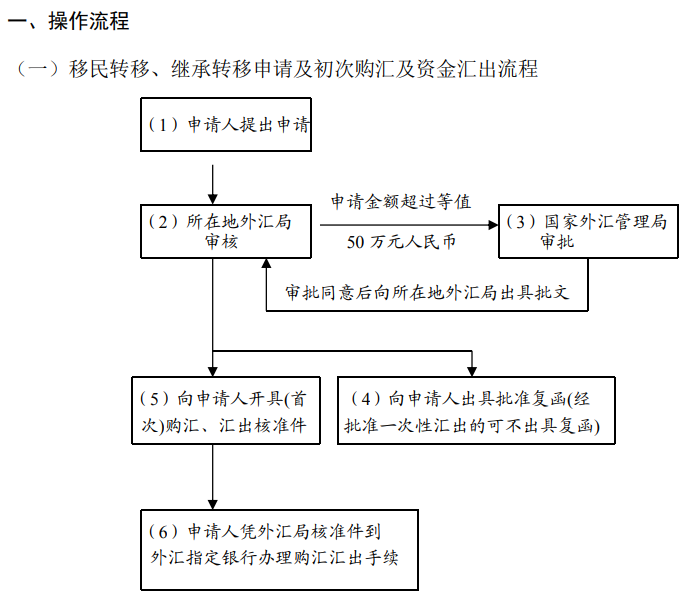
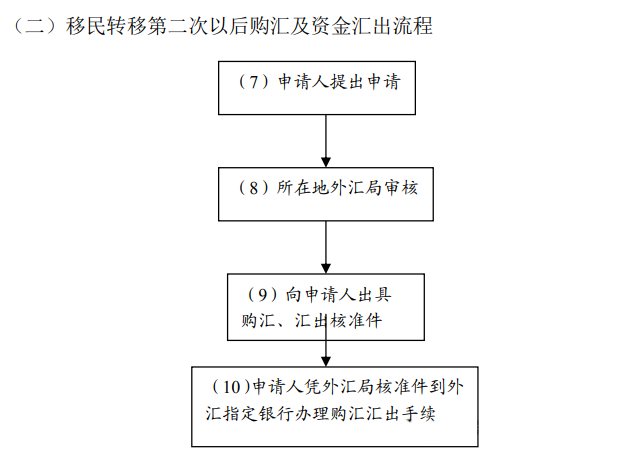
Infographic, source: Foreign Exchange Bureau

IV. What documents do I need to prepare when applying?
Preparing complete and compliant documents is the foundation of a successful application. The following is a list of core documents organized according to the official guidelines
The categories of documents, with specifics, are listed below:
1. Identification documents:
SingaporePR: Chinese passport, Singapore Permanent Residence Permit, Certificate of Settlement issued by the Chinese Embassy or Consulate General in Singapore, and Certificate of Cancellation of Domestic Household Registration.
Singapore Citizens: Singapore Passport, Certificate of Settlement issued by the Chinese Embassy or Consulate in Singapore, and Domestic Household Registration Certificate.
For naturalized persons,aNotarizedDeclaration of Identityis usually required toprove that the old and new identities are the same.
2. Application form:
①Written application (stating basic information, reasons for transfer, source of property, etc.).
② “Applicant Information Form for Foreign Transfer of Immigrant Property”.
③ “Foreign Exchange Business Application Form for External Transfer of Personal Property
3. Proof of the authority and origin of the property:
This is the core of the proof of the legitimacy of the assets, which should be prepared according to the type of assets:
①Property: housing title deeds, sale and purchase contracts, demolition and relocation compensation agreements,tax clearance certificates, and the bank stream of the account of the sale of housing.
② financial assets: certificate of deposit, stock/bond transaction records, proof of equity.
③ Business income: company financial statements, equity certificates, contracting and leasing contracts, tax payment certificates, etc.
(Please note: all assets need to be liquidated in the country before application)
4. Commissioning documents (if applicable):
If you entrust someone else to do it on your behalf, you must provide a notarized proxy agreement and proof of the agent’s identity.
Schematic diagram, source:unsplash

V. Important Reminders and Frequently Asked Questions
There is a time limit on the property that can be transferred:
Again, it is emphasized that the property that can be transferred must belegal property thatyoualready ownedbeforeyou obtained your SingaporePRor citizenship. Newly generated income in the country after migration cannot be remitted through this channel.
1. “Once-in-a-lifetime” opportunity
This policy is essentially a facilitation of immigrant settlement, not a duplicative cross-border passage of assets. In practice, most jurisdictions limit a person to one application for the transfer of immigrant property.
2、Assets must be legal and compliant
The property to be transferred must be legal property owned by the person andmust not be subject to ownership disputes with others.All sources of property must be clearly documented andtaxed in accordance with the law.
3. Underground channels are strictly prohibited
Be sure to go through the official channels mentioned above. Any transfer of assets through underground money changers, split foreign exchange purchases (ants moving), virtual currencies and other means is illegal and will facehuge fines and even criminal liability.
4. Receiving Assets in Singapore without Worries
Singapore law places no restrictions on foreigners holding local property (except for a few types subject to the Residential Properties Act). Legally remitted funds are free to be used for living, investment or property acquisition.
5. Advice on advance planning and consultation
As there may be minor differences in the details of specific materials and operation of foreign exchange bureaus around the world, the safest course of action is tomake a final confirmation and consultationwiththe branch of the foreign exchange bureau inyouroriginal domicilein person or by proxy before starting the process.

Schematic diagram, source:unsplash
[Conclusion]
In general, the legal transfer of domestic assets is subject to “rules”.It leaves a clear path for you, but the rules are strict and there is only one opportunity.
The safest way is to follow the official guidelines of the State Administration of Foreign Exchange (SAFE) and prepare step by step to complete this“financial migration” inyour life in an honorable way. Before doing so, it is highly recommended to consult with the local foreign exchange authorities again to get the most accurate implementation details.
*Reference sources: China Foreign Exchange Administration, Immigration Bureau, Caixin News Agency, the first financial, SingaporeICA, comprehensive information, reproduced with the source, invasion and deletion of contact.
…
👇 Plus V enters Singapore’s largest outbound community 👇