

As competition for skilled migration heats up, an offer from an employer in Sydneyopens the door for a 35-year-old marketing manager to migrate his family to Australia.
In recent years,the quota forAustralia’s independent skilled migrants (189visas) has continued to shrink,plummetingfrom30,375in the2023-24financial yearto16,900in the2024-25financial year, making competition extremely fierce.
Against this backdrop,the importance of Australia’s employer-sponsored visas has become increasingly prominent.Among them,the 186Employer-Sponsored Migration Visa, as the“Golden Gateway“for skilled migration, allows qualified overseas applicantsto obtain permanent residency in one stepthrough the sponsorship of an Australian employer.

I. Australia’s latest policy adjustments
1、Interpretation of Australia’s new policy
This year, there have been several noteworthy changes to Australian migration policy in the area of employer sponsorship.
The significant expansion of the list of occupations is the most notable adjustment this year, from216to456occupations, with the addition of Arts and Business occupations in particular, opening up possibilities for a wider range of applicants.
In terms of income thresholds, the core skills income thresholdhas been raisedfromA$70,000toA$73,150to ensure that overseas workers receive a fair market rate of pay.
The 482visa to186pathway has also been optimized. Under thenew legislation, which came into effect on November29,2025,the482(Skills in Demand) visa is officially classified asa statutory bridging visa to the186 TRT.
It is worth noting that the work experience requirement has been tightened. The new rules stipulate that onlyfull-time employment with an“approved sponsoring employer“counts towardsthe2years of experience requirement forthe 186 TRT, closing theloophole of“changing employers to make up for years of experience” inthe past.

Schematic diagram, source web
2、Under the tilted quota,186employer sponsorship becomes the preferred choice.
In the case of Australia’s2024-2025fiscal year migration quota totaling185,000, skilled migration occupies132,200places, accounting for about71%of the total quota.Among the various types of skilled migration visas, thequota of186employer-sponsored visas has shownsteady growth inrecent years.
Over the last five financial years, the employer-sponsored visa quota has grown significantly, from36,825to44,000, an increase of7,175places. This trend is a clear indication that the Australian Government is gradually shifting the focus of migration policy from independent skilled migration to employer-sponsored migration.
In starkcontrast tothe 189Independent Skilled Migration visa quota, which was almost halved,the 186Employer Sponsorship provides a more stable policy environment for prospective migrants.
3. Occupational scope: expansion to456areas of opportunity
With the expansion of the occupation list at the end of2024,the range of occupations covered by the186visa has increased dramatically, providing a diverse range of options for applicants from different backgrounds.
Information technology and engineering remain popular areas for applications, including software engineers, cybersecurity specialists, development programmers, and systems analysts. The engineering field covers a wide range of specialties such as structural engineers, electrical engineers, mechanical engineers, civil engineers, and more.
Healthcare occupations continue to be in short supply in Australia, andthere are many cases ofprofessionals such as registered nurses, physiotherapists, and medical laboratory scientistssuccessfully migratingthrough the186visa.
Notably, the addition of Arts and Business careers has opened up new avenues for professionals in this field, with marketing managers, financial and investment advisors, human resource consultants, project managers and more now having the opportunity to apply directly for permanent residence.
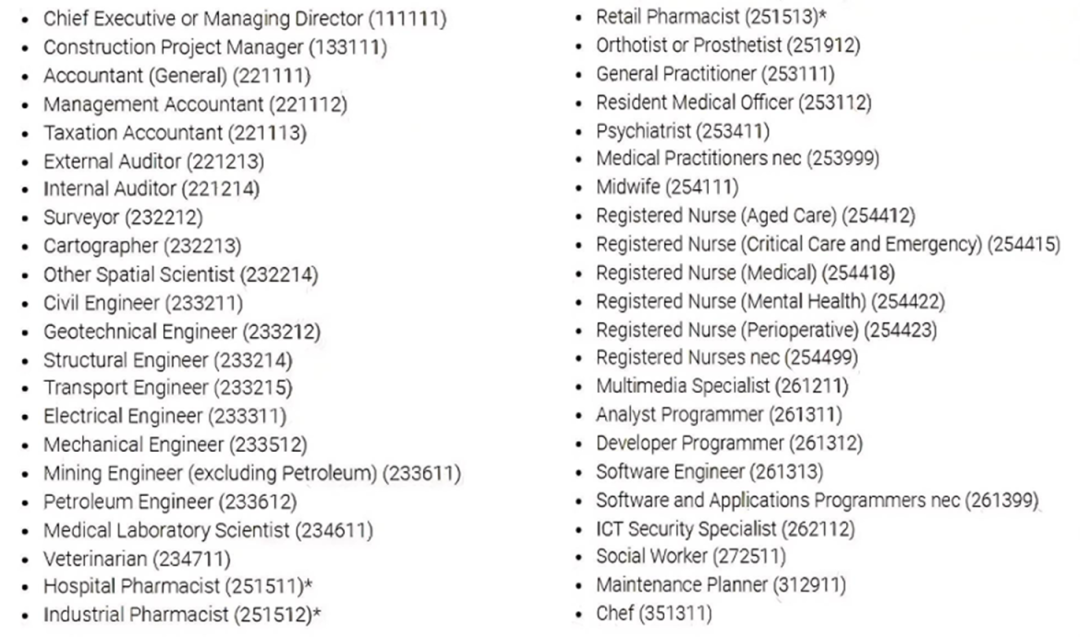
Chart/Priority Occupation List, click on larger image for details

Second,what are the advantages of186employer sponsorship?
1、Why choose186Employer Sponsored Visa?
The Australian186Employer Sponsored Visa, formally known as the EmployerNomination Scheme Visa, is a core component of Australia’s skilled migration system. This visa allows overseas skilled professionals to apply for and obtain permanent residency in Australia directly after being nominated for sponsorship by a qualified Australian employer.
The programimplements a simplified visa category system effectiveJuly1,2025, which unifies all existing visa categories into two:the Employer Nomination Program and the Remote Area Employer Sponsored Immigration Program.
It is worth noting thatat the end of2024, the Australian Department of Immigration made significant changes to the list of occupations,significantly expandingthe list of core skill occupations from216to456occupations.
This change means that more professionals in a wider range of fields now have the opportunity to apply directly for an186visathrough employer sponsorshipand obtain permanent residency in one step.
2、What are the advantages of186employer sponsorship?
The core advantage of the186visa is its“one-step“nature. In contrast to other migration routes that require a step-by-step process,successful applicants forthe 186visa are granted permanent residency in Australia without having to go through the temporary visa stage. Upon successful approval, the applicant and accompanying family members can enjoy the full benefits of Australia’s welfare system.
One person applies, the whole family immigratesis an important feature of the program, the spouse of the main applicant andchildrenunder23years old who are not financially independent can obtain permanent residency as secondary applicants together.
In addition,there is no residency restrictionafter being granted a visa, andapplicantsare free to choose where they live and work throughout Australia (including major cities such as Sydney and Melbourne), which is a significant advantage over other visa categories that require binding to a specific region.

Schematic diagram, source web

Third,186employer-sponsored application conditions, process
1. Personal qualifications and employer requirements
Successful applications for the186Employer Sponsored Visa require both the applicant’s own qualifications and the employer’s qualifications to be met.
The basic conditions that the applicant must fulfillinclude:
Not more than45years of age; English language proficiency of IELTS46or equivalent;at least3years of full-time work experience inthe past5 yearsthat is highly relevant to the nominated occupation; the nominated occupation must be on the Core Skills Occupation List; pass an assessment by a designated occupational assessment agency; pass a designated Australian health check and a criminal record check.
The qualifications employers must meetare equally stringent:
The business must be legally registered and operating in Australiaforat least2years; have an annual turnover of at least5full-time employees; be able to demonstrate that it is not possible to recruit suitable staff locally; offer salaries that are not lower than the market rate; and make the required contributions to the Australian Skills Fund.
2、Application path: direct application and temporary residence to permanent residence
There are two main categories of186visas and applicants can choose the most appropriate path for their situation:
The Direct Application categoryis suitable for those who have not yet worked in Australia or have only worked in Australia briefly. This pathway requires applicants to have a minimum of3years’ relevant work experience (which can include overseas experience), an English languagelevelof IELTS46(or equivalent) and must pass a vocational assessment.
The Temporary to Permanent Residence categoryis primarily forworking people whoare already in Australia on a482or457visa and working for a sponsoring employer. This pathway requires the applicant to have worked full-time for the sponsoring employerfor 2years, English language requirements may be lower, and most positions are exempt from occupational assessment.
The calculation of work experience under theTRTpathwaychanged significantly on November29,2025when the new regulations came into effect. Under theMigration Amendment (Skilled Visa Reform Technical Measures) Regulations 2025, onlyfull-time employment with an“approved sponsoring employer“counts towardthe 2-year work experience requirement. The following are some of the key changes
3. Application process: three stages from preparation to approval
The 186visa application process can be divided into three main stages and the overall cycle usually takes between12and17months.
Stage 1: Pre-preparation and employer matching, which takes about1to6months.
Applicants first need to confirm whether their occupation is on the456Core Skills Occupations List and then complete the appropriate occupational assessment. Meanwhile, finding and matching with a qualified Australian employer is a key task at this stage.
Stage 2: Employer Nomination Application, which takes about6to8months.
The employer submits a nomination application to the Immigration Department, a step that requires detailed documentation, including a job description, proof of salary, labor market test results, and proof of the business’s financial and operational status. This stage centers on proving that there is a genuine need for overseas talent for the position.
Stage 3: Visa application and processing, which takes about6to8months.
Once the employer nomination is approved, the applicant can submit the186visa application. Documents to be provided include proof of vocational assessment, proof of work experience, English transcripts, medical report, proof of no criminal record and a letter of approval of the employer’s nomination.
According to the2025data,50% ofapplicationswere processed within7months and90%within11months, giving an overall placement rate of98.4%.

Schematic diagram, source web

IV. Next steps, permanent residence rights and path to naturalization
Successfully obtainingan 186visa means obtainingpermanent residency in Australia, commonly known asa ‘green card‘.Unlike a Temporary Resident Visa,PRholders have the right to live, work and study in Australia on a permanent basis.
The main rights enjoyed by permanent residents include:
Indefinite residence in Australia; work and study anywhere in Australia; enrollment in Australia’s universal health insurance; eligibility to apply for Australian citizenship; sponsorship of eligible relatives for permanent residency; freedom to enter and leave Australia (subject to visa validity).
In terms of visa validity and renewal,the 186visa itself is a permanent visa, but the travel rights associated with it are usually ona five-year cycle. This means that although you have permanent residency, you may need to renew your travel rights if you need to travel internationally and re-enter Australia.
In order to renew travel rights, it is usually necessary to satisfythe“strong ties to Australia“requirement, for example: residence in Australia for at leasttwoyears; and evidence of business, cultural, employment or personal ties to Australia. Failure to meet the residency requirement may result in the granting of a resident return visa for a shorter period of time.
Afterholding a Permanent Resident Visa and meeting the residency requirements (usually4years, of which at least1 yearis as a permanent resident), you can apply for Australian citizenship and enjoy full citizenship rights.

Schematic diagram, source web
[Conclusion]
The Australian government’s policy favoring employer-sponsored visas has led toa steady increase in the186visa quota.
“As long as your occupation iswithin the list of456occupations, your English is up to standard, and you havethreeyears of relevant experience, you have the opportunity to get your green card in one step through this path.“This certainty is especially valuable in the fickle immigration landscape.
*Reference source: AustraliaDepartment of Home Affairs,homeaffairs, comprehensive news reports collated, reproduced with attribution, infringement and deletion of contact.