

In early2026, many people working, living or holding local bank accounts in Singapore received letters similar to the following one after another:
“You are required to confirm your tax residency statusunder the U.S. Foreign Account Tax Compliance Act (FATCA) and the Common Reporting Standard (CRS).“
“Yourcountry/regionof tax residency: Singapore“
“If the above information is inaccurate, please update your self-certification through the designated channel.“
This letter, from DBS Bank (DBS), is a standard move in the global process of making tax information transparent in recent years. Whether you hold an ordinary account, a VIP account, or a private bank account, you will have to face this issue as long as the account is opened in Singapore.

I.What areCRSandFATCAin the context of global tax transparency?
1. What isCRS?
CRS(Common Reporting Standard) isa global standard for the automatic exchange of tax information introduced bythe Organization for Economic Cooperation and Development (OECD) in2014. As of2026, more than100countries and territories have joined, withSingapore and China both beingCRSparticipating countries.
The core objective ofthe CRSis to prevent cross-border tax evasion by requiring financial institutions to collect information on accounts of non-domiciled tax residents and automatically exchange it annually to the tax resident country of the account holder.
2. What isFATCA?
FATCA(Foreign Account Tax Compliance Act) is a U.S.bill introducedin2010 that requires global financial institutions toreport account information of U.S. tax residentsto the U.S. Internal Revenue Service (IRS).
3. Why do you receive bank letters?
According to the Monetary Authority of Singapore (MAS), all local financial institutions are required to implementCRS&FATCAcompliance procedures by periodically requesting their customers to confirm or update their tax residency status.
If you receivethis letter fromthe DBS, it means that the bank is updating your tax file to ensure that the information is accurate and complies with international filing requirements.
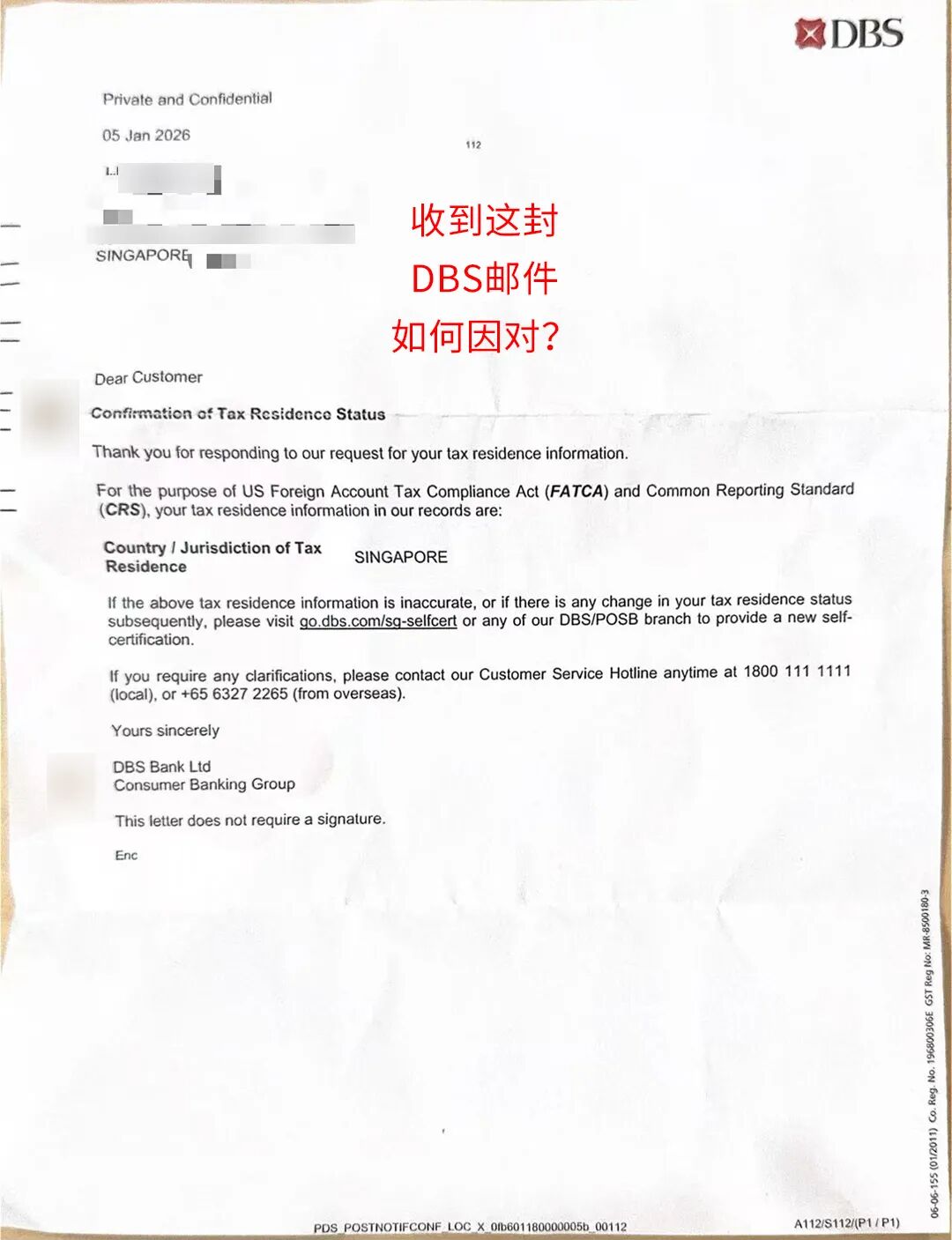
Pic/source: screenshot of DBS email

II. Definition of Tax Resident in Singapore,IRASOfficial Criteria
According tothe latest Income Tax Act2026issued bythe Inland Revenue Authority of Singapore (IRAS), the determination of being a Singapore TaxResident(Tax Resident) is mainly based on the following conditions:
1. Criteria for determining individual tax residents
Length of Residence Criteria:
A person is deemed to be a tax resident fora calendar year if he or she has physically resided or worked in Singaporefora total of183days or more inthat year.
Criteria for three years of continuous work:
Working in Singapore for three consecutive yearsmay be considered as tax residency for all three years, even if the first year of residence was less than183days.
The center of life and family is in Singapore:
Even if the period of residence is less than183days,IRASmay, at its discretion, recognize a person as a tax residentif the family, economic and social ties are predominantly in Singapore.
2、Non-Tax Resident (Non-Resident)
Residence for less than183daysin a calendar year;
or have no intention of residing permanently in Singapore.
Non-tax residents are generally subject to higher tax rates in Singapore and their account information maybe exchanged to other tax resident countriesthroughthe CRS.

Isholdingan EPequivalent to being a Singapore tax resident?
This is a common misconception.Holding a Singapore Employment Pass (EP) by itself does not automatically equate tobeing a“Singapore tax resident“, nor does it equate to“not beingexchanged forCRS“.
1. The key remains“tax residency“.
If you hold anEPandhave resided in Singapore for183daysin a year, you are usually considered a Singapore tax resident.
If you holdan EPbut have worked or lived abroad for a long time, you may still be considered a tax resident of another country.
2.CRSfiling logic
If you are aSingapore tax resident, your accounts in Singaporeareusuallynotexchanged to other countries.
If you are aChinese tax resident(even with anEP), information on your accounts in Singaporemay beexchanged to the Chinese tax authoritiesviathe CRS.
Schematic diagram, source: DBS

IV. How to Declare Tax Resident Status to Banks? TakeDBSas an example
1、How should I respond to receiving a confirmation letter from my bank?
If you receivethe following letter fromDBS:
“Confirm your tax residency status as: Singapore“
This means that the bank currently records you as a Singapore tax resident.If the information is correct, no action is required.
2. How to declare or update information?
If the information is incorrect (e.g. you are actually a Chinese tax resident), or if there is a change in status, it must be proactively updated:
Online filing:
Visitthe DBS websiteto submit a self-certification form.
Offline Processing:
Visit anyDBS/POSBbranch and submit the paper form.
Attention:
The DBS APPdoes not currently have an update portaland must be processed through the channels listed above.
Verbal confirmation from the account manager is not validand an official confirmation letter from the bank must be received to complete the process.
3. How do banks judge and declare?
DBSwill make a comprehensive judgment based on the information you submit such as self-certification, account activity, residential address and contact details. At the end of each year, the bank will report the non-resident account information to the Inland Revenue Authority of Singapore (IRAS), which will beexchangedbyIRASto the respective countriesviaCRS.

V. Special Reminders for Private Banking and VIP Account Holders
Tips:
DBS Private Bank, VIP and Ordinary Account holders, please make sure you check your tax residency status, as this is directly related to yourCRSinformation reporting.
Please note thatthe DBSmobile app does not provide a portal to update your tax status and verbal instructions from your account manager are not official. The only authoritative proof of tax residency status is the receipt of an official written confirmation letter from the bank.
To obtain this confirmation letter, you may refer to the following general procedure (applicable to DBS, OCBC, UOB, Standard Chartered Bank, HSBC,MaybankandCIMB, which operate on the slope):
1. Call the bank’s customer service hotline to make an application;
2. Apply in person at the bank’s head office or main branch(usually the head office is more experienced in handling international clients’ affairs andis more familiar with the process ofCRSidentity confirmation letter).
At the time of application, you can explicitly request the bank to issue a confirmation letter on official letterhead for you to keep or show to other branches for verification. Some banks (e.g. OCBC, UOB, etc.) also support the mailing of such confirmation letter directly to your registered residential address in Singapore.
Please takethis mattervery seriously as itrelates to your globalCRScompliance obligations and financial arrangements.

Schematic diagram, source: DBS
If you hold aDBSprivate bank or VIP account, it is even more important to place a high priority on declaring your tax status:
Accounts with larger amountsare more likely to be thefocus ofCRS;
Cross-border asset allocation is commonand tax residency can be more complicated;
Regular self-checks must be conductedto ensure that bank records are consistent with the actual situation.

VI. Summary and recommendations for action
1. What should you do?
Confirmation of status:Determine whether you are a Singapore tax residentbased onIRAScriteria.
Check bank correspondence: if you receiveaDBSconfirmation letter, check that the information is accurate.
Timely update: If there is any change, it will be updated immediately through the official channels.
Record keeping: Keep documents such as bank confirmation letters and self-certification forms.
2. Clarification of common misconceptions
“I have anEP, so I am a Singapore tax resident” → Wrong
“The account manager says I’m a resident, so I’m okay” → Wrong
“If I don’tupdate iton theapp, the bank won’t report it” → Error
3. Important reminders
Tax residency status not only affectsCRSfiling, but also directly relates to your personal income tax rate, overseas asset reporting obligations, etc. It is recommended to consult a professional tax advisor in case of complicated situations (e.g. dual tax residents).
[Conclusion]
With the global trend towards tax transparency, self-management and declaration of one’s tax residency status has become a necessary compliance obligation.
Whether you are a professional residing in Singapore for a long period of time or a business owner working across the border, you should take the initiative to understand the rules, file accurate returns and keep them up-to-date in order to be compliant and at the same time protect your financial privacy and tax rights.
“Tax status is no small matter; a letter of confirmation is a matter of global assets.“
*Reference sources:OECD,CRS, SingaporeIRAS,DBS, Lianhe Zaobao, comprehensive news reports collated, the specific operating rules, to the bank announced shall prevail, reproduced shall indicate the source, invasion and deletion of contact.
……
👇 Plus V enters Singapore’s largest outbound community 👇

Past Recommendations