

“If we can better integrate newcomers, we can build mutual trust between old and new citizens.“
OnJanuary26, Singapore’s Deputy Prime Minister and Minister for Trade and Industry, Mr. Gan Kim Yong, gave a blunt response to a question about the continuing decline in fertility at a forum at the Institute for Policy Studies. He pointed out that bringing in immigrants to sustain the core population of citizens and economic vitality has been “an unavoidable reality“.
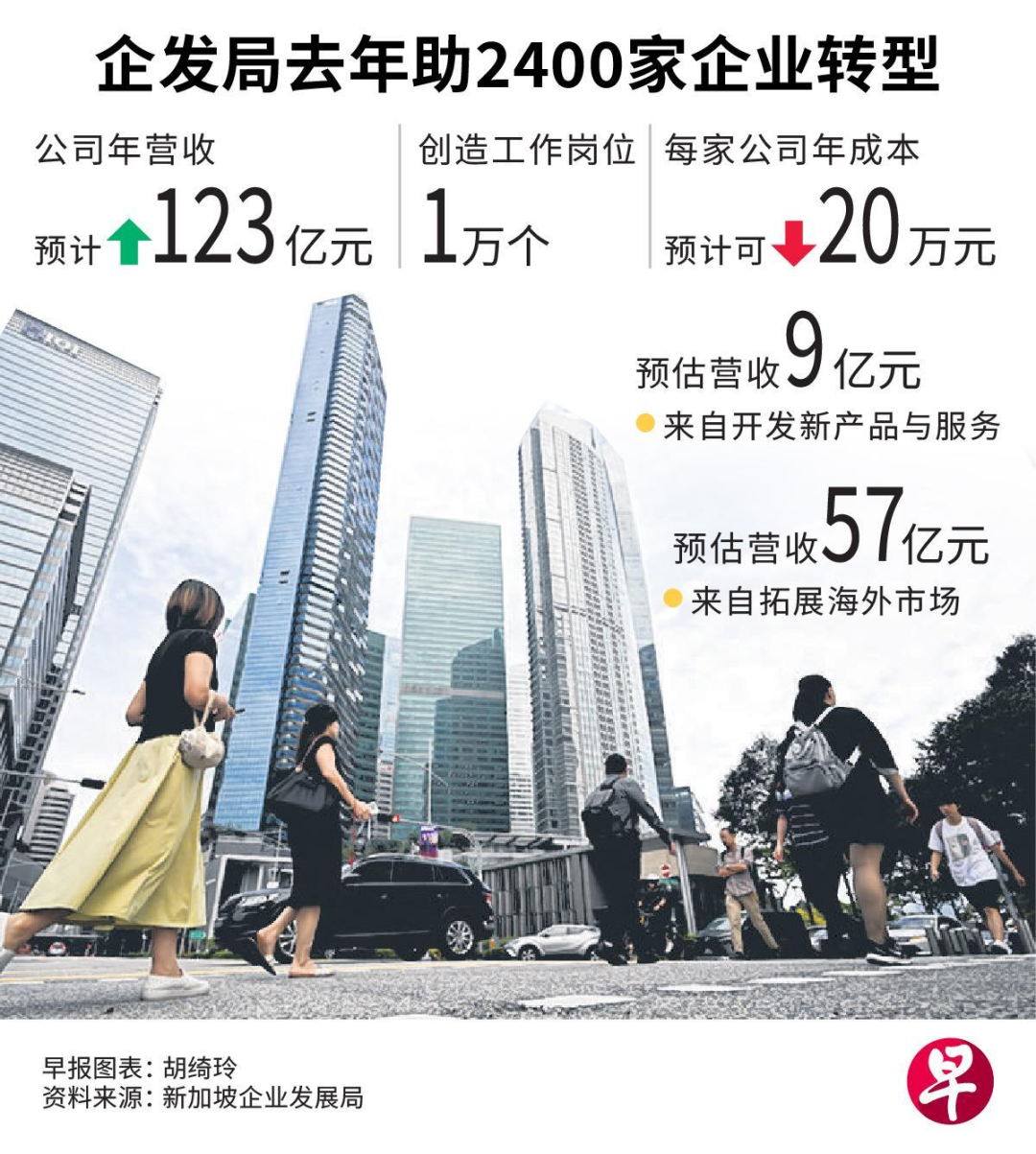
Just two days later, Enterprise Singapore released figures that assisted2,400local businesses to start their transformationlast year, which is expected to bring them$12.3billion in annual revenue growthand create10,000 skilled jobs.
On the one hand, there is a chronic lack of population growth, and on the other, there is an urgent need for talent as the economy transforms. For eligible expatriate professionals, the present moment may be a window of opportunity to focus on Singapore.

I. Demographic realities: the challenge of sustained low fertility
Singapore is facing a simple but stark arithmetic problem: too few people are being born and aging too fast.
In recent years, the total fertility rate (TFR) of Singapore residents hashovered around1.0for a long period of time, andwill be only0.97in2024, well below the2.1required to sustain natural population replacement.
This means that the size of Singapore’s civic core will inevitably continue to shrink if no external population is brought in.
Singapore’s Deputy Prime Minister, Mr. Gan Kim Yong, was not shy about this, describing the introduction of new immigrants as “an unavoidable reality“. Behind this candor is a sobering recognition of the demographic crisis at the policy-making level.
For a city-state without natural resources and dependent on human capital, maintaining a sizeable and vibrant core population is fundamental to economic and social development.
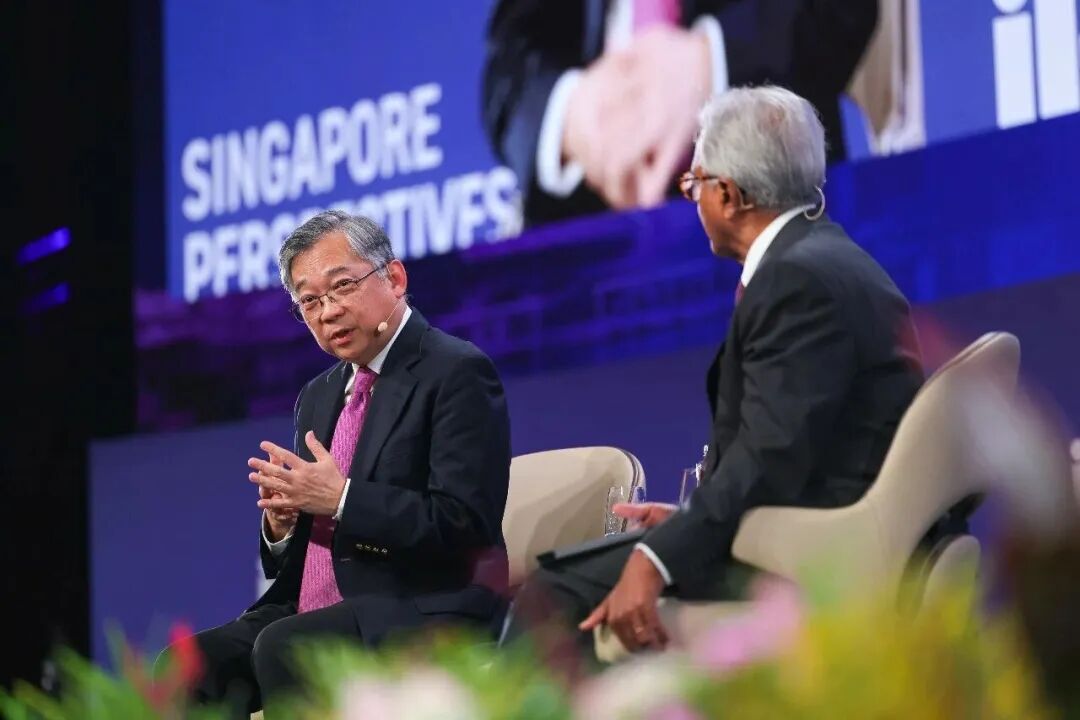
Photo/Singapore Yen Kim Yong, Source: Lianhe Zaobao, Erratum

II. Economic demand: enterprise transformation generates a large number of skilled jobs
In stark contrast to the demographic trend, there is a strong demand for talent as Singapore’s economy continues to transform and upgrade.
According todata released byEnterprise Singapore onJan.28, a total of2,400local enterpriseslaunched a transformationlast yearwith the support of the authorities to enhance their competitiveness by expanding into new markets and developing new products and services.
These enterprise transformations are expected to create10,000 skilled jobs. The Chairman of the EDC, Mr. Lee Chuen-tak, noted that despite the uncertainty in the global economic outlook, which has led to the scaling down of the business transformation projects, business actions have remained vibrant.
Particularly in the area of software and digitization, transformation projects that cost companies less to invest in but can quickly improve efficiency are favored. For example, local firm Wise and Logistics Management achieved revenue growth despite rising costs by introducing automation solutions.
Source:Enterprise Singapore, Lianhe Zaobao

III. Core contradiction: the collision of population gaps and job vacancies
The realities facing Singapore are: on the one hand, the growth of the local labor force is slowing down due to low fertility rates; on the other hand, economic restructuring and upgrading continue to create new demand for high-skilled jobs.
This structural contradiction makes the importation of foreign talent a necessary means of filling vacancies and maintaining the competitiveness of the economy.
Ms. Yau Hiu-ching, Executive Director of the EDC, revealed that enterprises participating in the transformation program mainly come from manufacturing, wholesale and trading industries, where the demand for skilled technical and managerial personnel is particularly acute.
In addition, Singapore enterprises are actively exploring overseas markets. In the past year, EDB supported companies to enter76markets, the widest overseas expansion in five years.
This outward-oriented development strategy further increases the demand for professionals with an international outlook and intercultural competence.
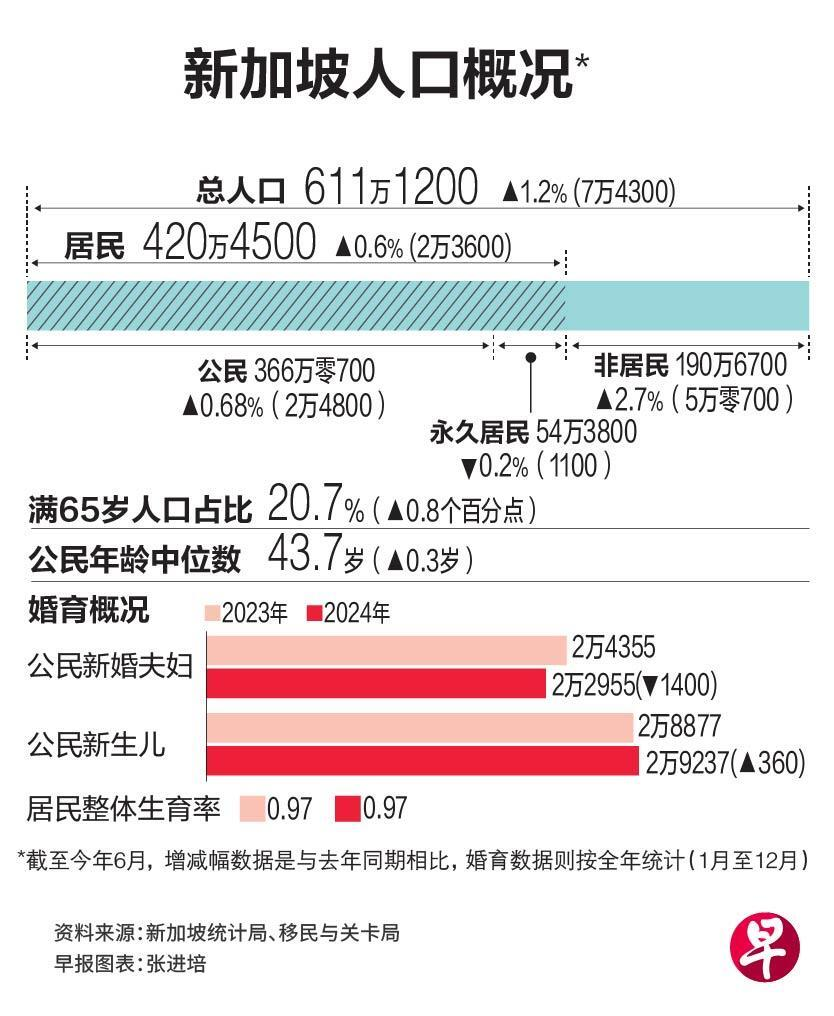
Source/Singapore’s population figures for 2025, source: Lianhe Zaobao

IV. Social integration: balancing differences and seeking common ground
In the face of the practical need to bring in new immigrants, how can Singapore avoid social polarization and promote the integration of the old and the new?
Deputy Prime Minister Ngan Kim Yong has put forward theconcept of “seeking common ground while preserving differences“, i.e. recognizing and preserving some of the differences, while at the same time working to expand the commonalities and create a wider common space.
He explained at the forum that“new immigrants spend most of their lives in different cultures and value systems before becoming Singaporeans, and are thus naturally different from native-born Singaporeans.“
To promote integration, Singapore has undertaken many programs and activities at the community level to encourage active participation and mutual understanding between new and existing citizens and permanent residents.
The Acting Minister for Culture, Community and Youth, Mr. Leung Chun-wai, pointed out thatthe key tobuilding a“We First“society lies in the“deep transformation of human relationships“at , rather than in mere resource inputs or legislative tools.

Photo/Singapore Leung Chun Wai, Source: Lianhe Zaobao, Erratum

V. Policy framework:window of opportunity forEPandPRapplications
For expatriate professionals, the current economic transition in Singapore may provide a noteworthy application window.
Singaporehas a relatively transparent and points-based assessment systemfor Employment Pass (EP) and Permanent Resident (PR) applications. As the economic transformation creates a large number of skilled jobs, professionals who meet Singapore’s needs may find the application process smoother.
The demand for professionals is particularly strong in areas where Singapore is focusing its efforts, such as financial technology, biomedicine and logistics automation.
The EDC plans to set up two additional centers in Boston and Austin in the United States this year to support local enterprises in entering these high-growth markets. This internationalization will also give rise to more jobs that require cross-border work experience.
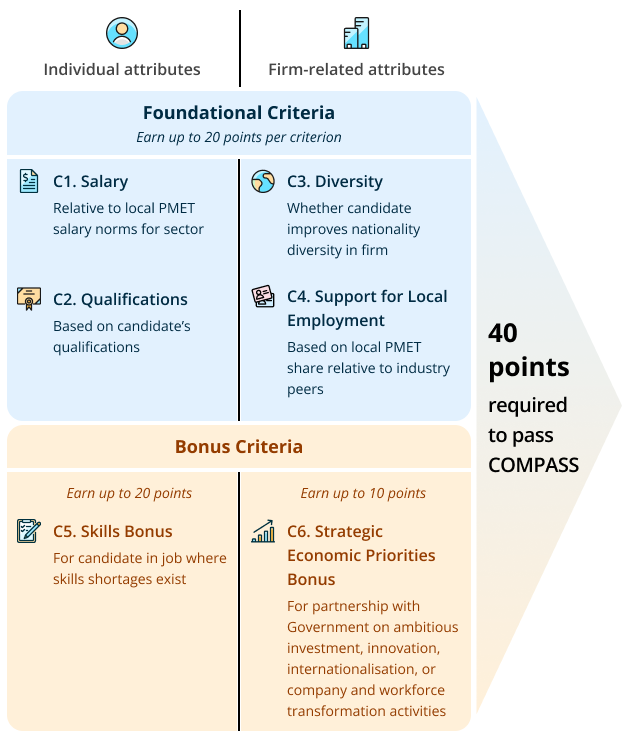
Photo/Singapore EP COMPASS, Source: MOM

VI. Long-term perspective: buildinginclusive societies that“put us first“
Bringing in new immigrants is not just a short-term means of filling the labor gap, but a long-term strategy to shape Singapore’s future society.
Acting Minister Leung Chun-wai emphasized that“We First“must become a way of life, which means that society needs to cultivate an“other-centred“culture where people naturally think of others in their daily lives.
There have been some encouraging signs in Singaporean society, such as in Yio Chu Kang, where more than a dozen residents have volunteered toprepare meals and organize activitiesfor about40elderly peopleevery month, with the necessary ingredients provided by the local Chamber of Commerce and Industry.
This spontaneous community support network demonstrates the potential for integration at the grassroots level of Singaporean society. When residents, old and new, participate in community building together, a stronger sense of belonging and social cohesion is naturally fostered.
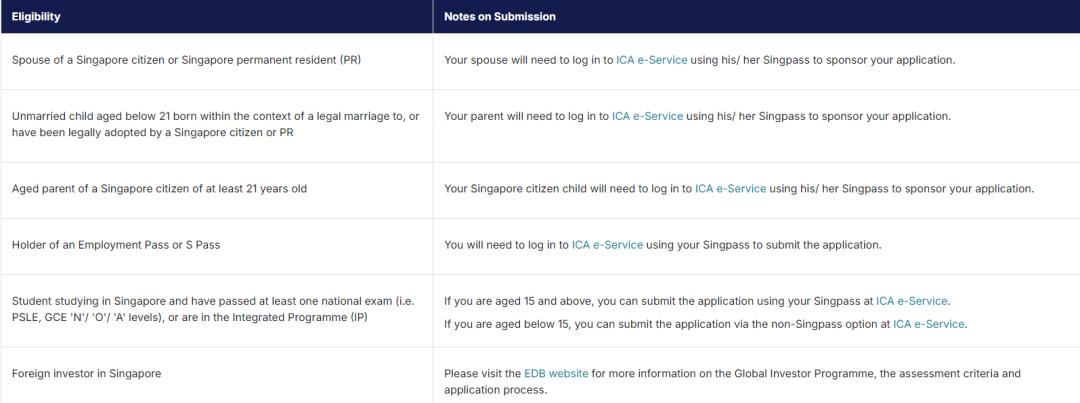
Picture/Singapore PR Application Suitable Crowd, Source: ICA
Window of opportunity: when economic transition meets demographic gap
Today, Singapore stands at a critical crossroads.
On the one hand, there is the persistently bottoming out of the fertility rate of the population and the deepening ageing of the population, which constitute fundamental challenges for the country’s long-term development.
On the other hand, it is the state-led economic transformation and industrial upgrading that is moving at full speed, creating a large number of high-value jobs that need to be filled.
Enterprise Singapore’s figures provide the most direct footnote to this.2,400transformed enterprises,$12.3billion in projected revenue growth, and especially those10,000newskilled jobs, are proof of the economy’s vitality and a clear call for talent.
Widely spread across cutting-edge sectors such as manufacturing, trade, logistics, and fintech, these are not ordinary positions, but key engines that will drive the next phase of Singapore’s economic growth.
This window is a time for Singapore to proactively replenish its talent pool, as well as an opportunity for individuals to capitalize on a new phase of their career and development. Therefore, now isthe right time toapply forEPandPRin Singapore, so make sure you seize the opportunity and act now!
*Reference sources:ICASingapore,MOM,Enterprise Singapore,Lianhe Zaobao, comprehensive news reports collated, reprinted with attribution, infringement and deletion of contact.
…
👇 Plus V enters Singapore’s largest outbound community 👇