

In Singapore, a country renowned for the quality of its education,EduTrustcertification is recognized as a benchmark of excellence in the field of private education.
It is more than just a certificate on the wall, it is astrong endorsement fromSkillsFuture Singapore (SSG) that private education institutions have met and continue to maintain high international standards in all aspects of management, teaching and student services.
For private education institutions planning to grow or enhance their brand in Singapore, a deep understanding and successful acquisition ofEduTrustcertification is a critical step towards successful and compliant operations.

I.Overview ofEduTrustCertification:
Authoritative certification of quality
The EduTrustCertification Scheme(EduTrust) isthe core quality assurance system managed bySSG.
Its core purpose is toidentify and recognize private education institutions (PEIs)that consistently maintain high standards in the overall delivery of educational services and achieve positive student outcomes through continuous improvement.
The certification is open to two main categories of applicants:
Business entities thatare registered in Singapore and haveaCorppassaccount, as well asforeign business entities that do not yet have a physical presence in Singapore but are interested in providing educational services.

Schematic diagram, source: United Daily News
It is important to note that third-party filers are unable to file on behalf of the organization, ensuring direct responsibility for the subject of the filing.
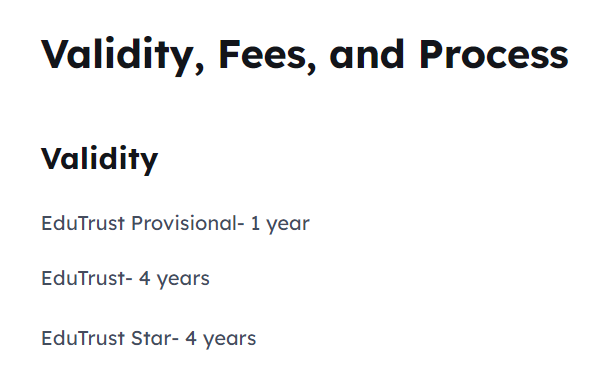
1、EduTrust Provisional(Provisional Accreditation)
1 year, awarded to organizations that have achieved a basic level of excellence in management and service delivery, demonstrating that they have established a framework that meets the basic requirements, subject to continuous improvement over the next year.
2.EduTrust (Standard Certification)
4 years, awarded to organizations that have demonstrated satisfactory and commendable performance in management and services, proving that they have consistently and consistently achieved excellence in their core areas.
3、EduTrust Star
4 years, this is the highest level of accreditation awarded to top institutions that demonstrate excellence in all aspects and industry leadership.
Source:Gobusiness

II. Who can apply:
7 prerequisites for clarity
Not all educational institutions are eligible to apply forEduTrust, andapplicants must meet seven strictpre-requisitesthat must be met not only at the time of application, but alsoon an ongoing basisonce accreditation is granted. Failure to meet any of these requirements may result in rejection of the application or suspension or termination of accreditation.
1.SSGregistration and years ofexperience/rating
You must be aPEIregisteredunderSSG’sEnhanced Registration Framework(ERF)and must meet any of the following criteria:
SituationA:Has been registered for at least4years; or
ScenarioB:If enrollment is less than4years old, both:
(i) havea credit rating ofat least “Band 3” fromSSG‘s designated agencywithin the3 monthsprior to application;
(ii) havea track record of compliant course operations and well-established processesfor at least1 year.
2. Implementation of the Tuition Protection Program
Institutions are required topurchase TuitionProtection Plan Group (FPS-G)insurancefor the full tuition of all studentsthroughan insurance company designated bySSG.EffectiveJanuary1,2024,FPS-Ghas fully replaced the individual insurance model. The insurance companies will work together to determine an annual Maximum Insurable Limit (MIL), which will serve as a benefit cap,based on the institution’s financial situation, etc.
3. Continuous maintenance of credit ratings
A credit rating ofat least “Band 3“ must be consistently maintainedthroughout theEduTrustcertification period.
4. Appointment of management representatives
AManagement Representative (MR)must be appointed, whowill be responsible forinterfacingwithSSGand be fully authorized to drive the implementation of all certification requirements.
5. Participation in pre-assessment meetings
Ifapplying for the first time, orreapplying aftercertificationhas been voluntarily withdrawn, suspended, or terminated, you must attend anSSGpre-assessment meeting.
6. Submission of documents on time and in compliance
All required documentsmust besubmitted inthe format and within the time limitsspecified bySSG.
7. Full payment of expenses
The relevant application and assessment fees set bySSGmust be paid in full.
Important note: These seven“prerequisites“are thebasic thresholdfor application.As for the real quality assessment,SSGwillconduct an in-depth assessment and score the organizationbased on theseven assessment criteria (such as management commitment, academic processes, student outcomes, etc.) intheEduTrustGuidance Document Version4, and ultimately decide which level of accreditation to award.

Schematic diagram, source: United Daily News

III. How to apply:
Types, Processes and Site Assessments
Applications are uniformlysubmitted onlinethrough ZF Singapore’s GoBusiness Licensingplatform. There are 4 types of applications based on the status of the organization:
NEW APPLICATION:Forinstitutions thatare new but have been enrolledfor 4years or have never been accredited.
Renewal application:must besubmittedat least5 monthsprior to the expiration of the current certificationto ensure a seamless transition.
Mid-Term Guidance Assessment:Institutions with four-year accreditation are required toapply for this assessmentat leastfive monthsbefore the end of the second year of accreditation, focusing on supporting institutional improvement.
SPECIAL EVALUATION:SSGmay direct an institution to undergo a special evaluationwhenSSGhas reason to believe that the institution may have violated the terms of its accreditation.
The application process is divided into 3 main stages:
Phase I: Adequate preparation
Complete a management review and internal assessment within12 monthsprior to application.
If you wish to apply for an exemption due to special circumstances, you need to submit your assessment in advance according to the official process.
Stage 2: Formal submission
Submit an online application and pay the Stage 1 feethrough theGoBusinessplatform.
Submitelectronic copies of the documents in PartAofthe Document Submission Checklist within7 daysofreceipt of theSSGnotification.
Phase 3: On-Site Assessment and Licensing
SSGwill arrange for an assessor to conduct a document review and on-site assessment. The on-site assessment usually includes:
Interviews with management, faculty, staff, and students.
Classroom Observation and Site Verification.
Review a sample of submissions.
Assessment Key Points: assessment results are based on an overall score anda score ofat least “Band 3“ must be achieved in several key areas (e.g., tuition protection, student attendance, academic processes).If standards are not met,SSGmay require the institution to submit a Corrective Action Plan (CAP), and an invalidCAPmay result in a downgrade of the award grade.
The entire accreditation process usually takes about five monthsfrom the timePEIsubmits the documents to the time it receives the results, provided the documents are submitted in full. After passing all assessments, the institution is required to pay a Phase II fee, after which it will be formally accredited.

Schematic diagram, source: United Daily News

IV. Cost structure and return on value
The application feeis categorized into3tiersbased on theannual turnoverof the institution:
Small:Less thanS$1 million;
Medium:betweenS$1 million andS$15 million;
Large:overS$15 million.
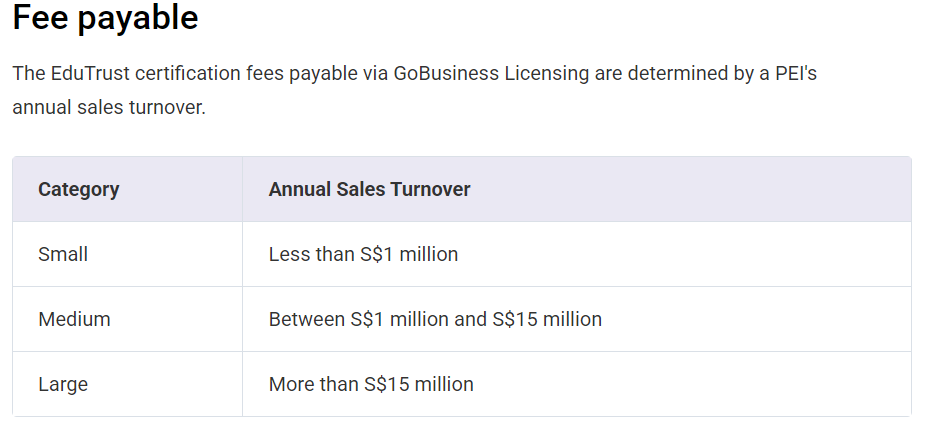
Photo credit:Training Partners Gateway
Payment of fees is divided into two stages (both inclusive of GST):
Stage 1 (payment on application)
Includesanon-refundableapplication fee (S$130.80) and an assessment fee. The assessment fee varies depending on the type of application and the size of the organization (e.g.S$1,853.00for a new application from a medium-sized organization).
Phase II (Payment prior to certification)
Payment of annual accreditation fees. Institutions that receive four-year accreditation are usually required to pay a one-time fee for two years (e.g.,S$2,616for a mid-sized institution).

Schematic diagram, source: United Daily News

V. Core values and strategic role of accreditation
BeingEduTrustcertified means that the institution operates under an authoritative and transparent quality framework, which is worth much more than a piece of paper:
1. The Ultimate Guarantee and Commitment to Students
This is the most fundamental role of accreditation. Through mandatoryFPStuition protection, rigorous academic process management and student care provisions, accreditation maximizes the financial benefits and quality of education for students.
Also,onlyEduTrustaccredited institutions are eligible to apply for Singapore Student’s Pass for full-time international students.
2. Strong market reputation and enrollment advantages
EduTrustaccreditation is the“gold standard“for the quality of private education in Singapore. Being accredited, especially in the international student market, significantly enhances the trust of prospective students and parents, and is the key to standing out from the crowd.
For Chinese students, choosingan institution with a4-yearEduTrustcertificationis one of the most important prerequisites for their program to be certified as a qualification by the Chinese Ministry of Education’s Service Center for Scholarly Exchange.
3. Drive internal continuous improvement and operational excellence
The accreditation system covers the full range of legal, financial and administrative compliance requirements for institutions’ operations. Periodic mid-term evaluations and renewals drive continuous self-review and improvement, creating a virtuous cycle of excellence.

Schematic diagram, source: United Daily News

VI. Possible activities and strategic opportunities after certification
Successfully obtainingEduTrustcertification, especially the full4-yearcertification, will greatly broaden the boundaries of the organization’s strategic development:
1、Legal enrollment of international students, expanding the global student population
This is the core right, the cornerstone of the institution’s international development.
2. Provision of ZF-funded courses
Eligible to apply to become aContinuing Education and Training Centre (CETC)and offercourses subsidized underSingapore’sSkillsFutureto attract a wider range of local in-service learners.
3、Establish accreditation cooperation with top domestic and foreign educational institutions
Under a rigorous partner review framework, high-quality dual courses or cooperative programs can be legally established with overseas universities, local companies, etc. to enhance the academic brand.
4. Enhancing the flexibility of tuition collection
According toSSG,an institutionwith a validEduTrustcertification can collect tuition for up to twelve months at any one time, which gives the institution more room for cash flow management and course planning.

Schematic diagram, source: United Daily News
[Conclusion]
In a nutshell,EduTrustcertification is the “passport“and“quality badge“for Singapore’s private education institutions to integrate into the country’s high-quality education system and to gain access to the local and international markets.
It guides institutions from meeting basic compliance to the pursuit of total excellence through a set of rigorous, systematic standards.
For organizations interested in building a long-term reputation and competitiveness in the Singapore education sector, committingresources to obtain and maintain this accreditation is a strategically valuable investment.
*Reference sources: SingaporeMOE, SSG,Training Partners Gateway,Gobusiness, Lianhe Zaobao, reproduced with attribution, infringement and deletion contact.
…
👇 Plus V enters Singapore’s largest outbound community 👇

Past Recommendations