

Between the modern silhouette of Kuala Lumpur’s Petronas Twin Towers and the nostalgic flavor of Penang’s old streets, Malaysia is becoming an indispensable strategic pivot point for global enterprises to lay their groundwork in Southeast Asia.
“A Chinese tech company focusing on smart homes has successfully launched its products into six ASEAN markets just a year after setting up a research and development center in Malaysia.“Such stories are playing out frequently in Southeast Asia.
Malaysia, a country located in the heart of ASEAN,is attracting more and more international companies to register their companiesdue to its stable political environment, mature business legal system and geographical location connecting East and West.

i. the Malaysian commercial scene.
ASEAN Gateway for Foreign Enterprises
Malaysia is more than just a country; it is astrategic gateway to the ASEAN market of650million people.According to the World Bank’s Doing Business report, Malaysia continues to rank high globally, particularly in the indicators of “Starting a Business“,“Access to Electricity“and“Contract Enforcement“. in particular in indicators such as “Starting a Business”, “Access to Electricity” and “Contract Enforcement”.
This country has a well-established legal framework, including the Company Law2016, the Investment Promotion Law, and the Foreign Investment Law, which provide clear legal safeguards for businesses.
For Chinese companies wishing to enter the ASEAN market, Malaysia is not only a gateway to Southeast Asia, but also a bridge between Asia and the world.
Malaysia is also animportant node in theBelt and RoadInitiativethat connects China with ASEANand is of strategic significance.

Schematic diagram, source web

II. Analysis of multiple advantages.
Why Malaysia?
What makes Malaysia a popular choice for companies going overseas? Its advantages are reflected in several dimensions.
Recently, we have successfully registered a Malaysian company for our client. If you have such a need, please contact us in time for our account manager to assess and develop the appropriate solution for you.
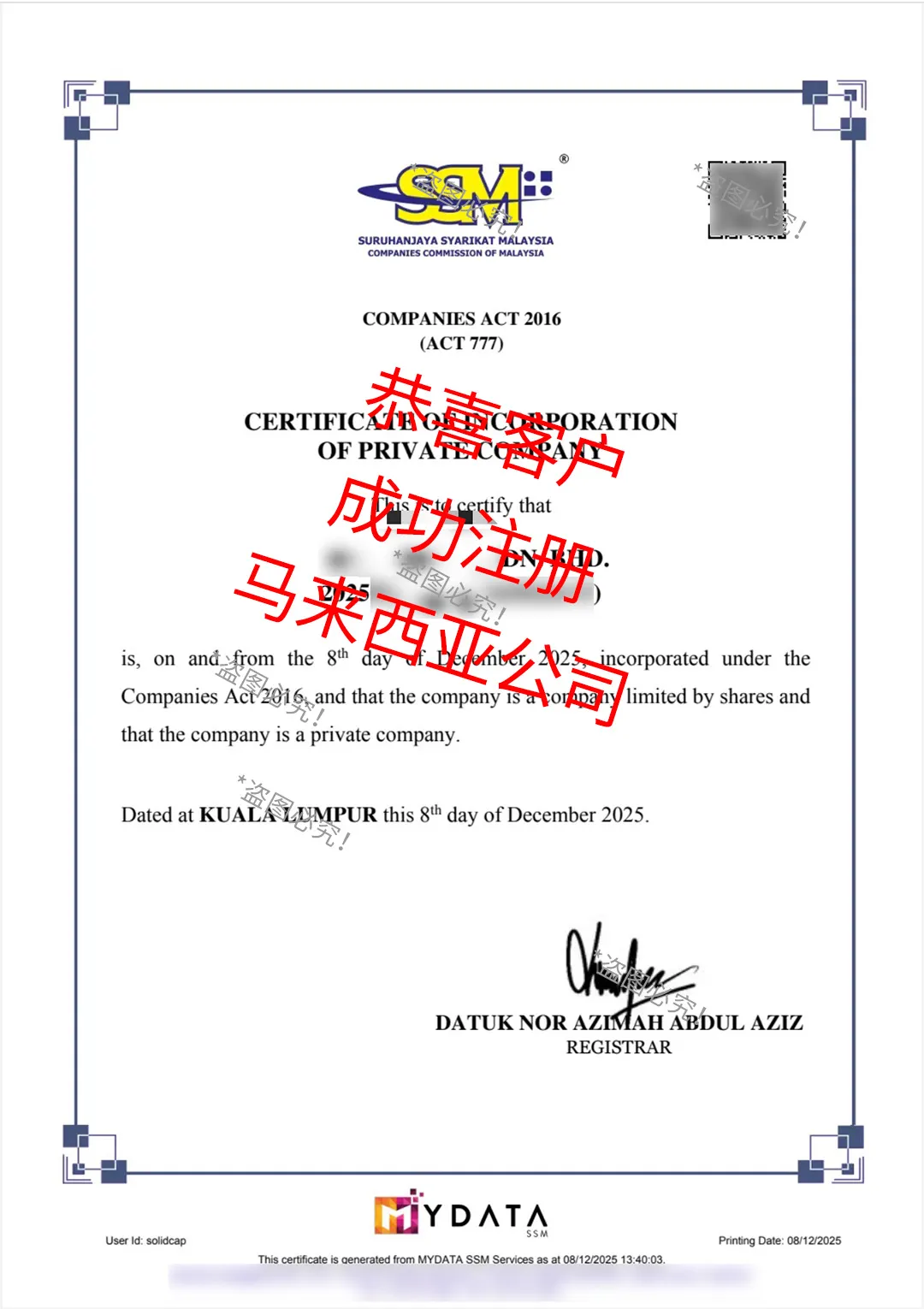
Picture/Customer successfully registered Malaysia company, stolen picture must be punished!
The corporate tax rate in Malaysia is24%but can be reduced to15-17%for qualifying SMEs. This is in contrast to the higher corporate income tax rates in some countries, and many companies can reduce their effective tax liability through sound tax planning.
Malaysia’s ZF is open to foreign investment,allowing100%foreign ownershipwithout the need for a local partner, and has introduced a variety of incentives, such as tax breaks for businesses in the high-tech, manufacturing and agricultural sectors.
Malaysia has abundant and relatively low-cost labor resources. As a multi-ethnic country, Malaysia has a large pool of well-educated labor force, especially in the fields of science and technology, finance and manufacturing.
Malaysia’s ZF is vigorously promoting digital transformation and encouraging technological innovation and the development of the Internet economy. Kuala Lumpur and Penang have become one of the technology centers in Southeast Asia.

Schematic diagram, source web

III. Precise matching.
Which businesses are suitable for registration in Malaysia?
Not all businesses are suitable for registering a company in Malaysia, but the following types of businesses can maximize the advantages of Malaysia:
Trading and cross-border e-commerce companies planning to enter the Southeast Asian market can take advantage of Malaysia‘s excellent geographic location and logistics networkto distribute their products throughout the ASEAN region.
Malaysia’s ZF is actively promotingthe “Smart Nation2030″program, which aims to build a nation centered on digital technology. Technology and Internet companies can find a wealth of technical talent and development opportunities here.
Manufacturing companies wishing to reduce manufacturing costs while maintaining product quality can set up production bases in Malaysia to take advantage of the local industrial base and relatively low operating costs.
Malaysia has a large and well-educated workforce, especially in the financial services sector. Financial services and professional consulting firms could establish regional service centers here.
Malaysia has a large Chinese community with less language communication barriers. Chinese enterprises wishing to develop overseas business can take advantage of this advantage to adapt to the local market more quickly.

Schematic diagram, source web

iv. registering the full process.
Key steps from condition to completion
It is vital to understand the specific requirements and process of registering a Malaysian company. The table below organizes the core requirements and detailed steps for registering a Malaysian company:
Enrollment dimensions, as requested below:
1, company type:Sdn Bhdis the most common and suitable for small and medium-sized enterprises (SMEs), with independent legal personality and limited liability of shareholders.
2. Shareholder requirements:Sdn Bhdis the most common and suitable for small and medium-sized enterprises (SMEs), with independent legal personality and limited shareholder liability.
2. Director Requirements:At leastonedirector, at leastoneof whommust be an “ordinary resident” of Malaysia (a long-term resident citizen, permanent resident or holder of a long-term residence permit such as a “second home”).
4. Registered capital:the statutory minimum isRM1, but it is recommended to set a reasonable capital (usuallyRM1,000-10,000)according to business needs; specific industries have actual capital requirements for foreign capital.
5. Company Secretary:Acompany secretaryholding aqualification recognized bySSMmust beappointed within30daysof the incorporation of the company.
6. Registered Address:A valid physical address in Malaysia (either a physical office or a compliant virtual address) is required to receive ZF letters.
7. Company name:Provide2-3alternative English namesendingwith “SDN. BHD.”;SSMchecking isrequired toensure that the name is not duplicated and does not contain sensitive words.
8, the registration process:name search → document preparation → submitted tothe SSMfor approval → receive a certificate → follow-up registration (tax, bank accounts, etc.), the whole process with the assistance of professional organizations about2 to 4weeks.
9. Key institutions:Companies Commission (SSM), Inland Revenue Department (LHDN), Malaysian Investment Development Authority (MIDA).

Schematic diagram, source web
The registration process is explained in detail:
The first stepin registering a company in Malaysiais tosubmit2-3alternative company names for searchingthroughSSMsystem, this process usually takes1-3working days. The name is valid for3 monthsafter approval.
The next step is to prepare the registration documents, including articles of incorporation, proof of identity of directors and shareholders, and proof of registered address. For foreign investors, it is important to note that certified English translations are required for all non-English documents.
Once the documents are ready,submit the applicationthroughSSM‘sMyCoIDonline system.SSM‘s review usually takes3-5working days, and if the documents are complete and compliant, approval will be granted very quickly.
When a company is successfully registered, it will receive a Certificateof Incorporationand a unique entity number. However, the completion of the registration does not mean that the business can be carried out immediately, there are still some follow-up procedures that need to be carried out.
A qualified company secretarymustbe appointed within30daysof incorporation.Tax registrationwith the Inland Revenue Department of Malaysia (LHDN) is also required toobtain a tax number.
Opening a company bank account is also a necessary step, especially for foreign companies, and the process may take1-4weeks. If the company’s business involves specific industries, such as education, finance, healthcare, etc., it is also necessary to apply for relevant industry licenses.

Schematic diagram, source web

v. tax and compliance.
Continuing responsibility after registration
Successful company registration is just the beginning, understanding Malaysia’s tax and compliance requirements is equally important.
Malaysia has a sales and service tax (SST) regime wherebusinesses withan annual turnover of up toRM500,000for taxable servicesandRM1.5millionfor specified construction servicesare required to register forSST.
Notably,in 2025 the Department of the Treasuryset an adaptation periodforthe SSTexpansion of the tax, with eligible businessescompleting their registration byDecember31 tobe exempt from penalties.
In terms of corporate income tax, Malaysia has asystem of estimated tax, whereby companies are required to pay tax in quarterly installments based on their estimated profits for the year.
For annual compliance, Malaysia adopts a dual timeline system:annual returns need to besubmitted toSSMwithin30daysafter the anniversary of incorporation; while financial statements need to besubmitted within6 monthsafter the end of the financial year.Tax returns are required to besubmitted toLHDNwithin7 monthsafter the end of the financial year.
For companies wishing to employ foreign workers, it is important to note that the approval of the foreign worker quota in Malaysia is linked to the actual capital contribution, which is a factor to be considered in the actual operation of many foreign companies.

Schematic diagram, source web
[Conclusion]
With the deepening economic integration of ASEAN, barriers to trade within the region are gradually being removed. Malaysia, as the hub country of ASEAN, hasbecome increasingly prominent in the regional supply chain, with business infrastructure ratings that are among the highest in the region.
From smart homes to fintech, from traditional manufacturing to green energy, Malaysia’s business soil is nurturing the regional dreams of countless multinational companies.
When the global supply chain is rearranged, when the wave of digital economy sweeps through Southeast Asia, Malaysia company registration is no longer a simple administrative procedure, but a strategic choice for enterprises to grasp regional growth opportunities.
*Reference sources:SSMMalaysia,ESD,LHDN,MIDA, comprehensive news reports collated, reproduced with attribution, infringement and deletion contact.
…
👇 Plus V enters Singapore’s largest outbound community 👇

Past Recommendations