

In recent years, Singapore has become an increasingly prominent hub in the global map of wealth and philanthropy. This is reflected not only in the continued inflow of international capital, but also in the profound changes in regional economic linkages and asset allocation.
Understanding the ongoing trends and a clear and feasible path to the ground has become a key necessity for families seeking robust growth, intergenerational inheritance and globalization.

I.3major trends to corroborate
The gravitational pull of wealth in Singapore
Currently, the wealth management ecosystem in Southeast Asia, with Singapore at its core, is exhibiting3clear and interrelated trends.
1. Strategic shift of global philanthropic capital: Singapore is one of the key destinations
Singapore is becoming one of the top destinations for global philanthropic foundations to expand their Asian operations and set up regional hubs.
This choice goes beyond purely tax considerations, as it is a vote of confidence in Singapore’s stable governance environment, transparent regulatory system and mature financial ecosystem. Its well-established framework of tax incentives for charitable donations (e.g. tax deductions for donations to local charitable organizations) providesa good groundfor the Foundation to practicethe concept of“mission-aligned investing“.
The establishment of foundation offices in Singapore byinternational philanthropists such as BillGates, and the growing number of multinational conglomerates aiming to achieve centennial legacies relocating their global headquarters and family offices to Singapore, are vivid illustrations of this trend.
They see Singapore as a jurisdiction that offers rule of law safeguards, regulatory maturity and a long-term capital management framework

Photo/Bill Gates, Source: United Daily News
2. The Rise of Johor and Opportunities:6Family Offices have landed and13are preparing to move in
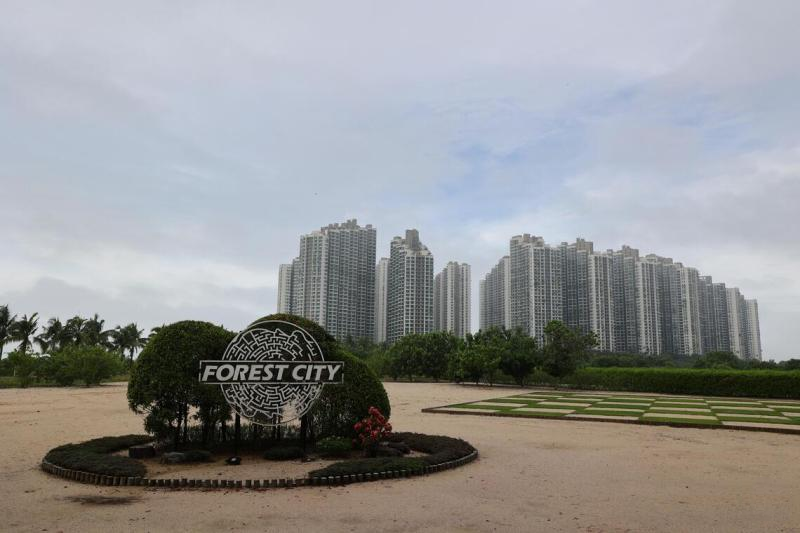
The radiation effect of Singapore is giving rise to new regional opportunities. Forest City, Johor, Malaysia, just across the water from Singapore, has been designated as a“special financial zone“and approved as a“tax-free island“, aiming to attract international capital and family offices.
ZF Malaysia has introduced a range of competitive incentives for this purpose, most notablya0%tax creditfor single family officesanda preferential personal income tax rate of15%for knowledge workers.
This strategy is rapidly gaining market traction. According to the Malaysian Investment Development Authority (MIDA),11companies(includingeightfamily offices from Malaysia, Singapore, Indonesia and Taiwan) have expressed interest in setting up in the Forest City Financial District.
This development clearly demonstrates that many investors are adoptinga “Singapore headquarters+regional presence“strategy, leveraging on the cost and policy advantages of the Forest City as an extension of their business, further entrenching Singapore as a central decision-making and management center.
Schematic diagram, source: United Daily News
3. Demand for SGD asset allocation continues to strengthen, doubling the size of focused local portfolio management
As family offices settle in, their impact on Singapore’s local capital market is deepening. According to industry reports,the number of single family offices in Singapore hassurged toover2,000by theend of2024, upfromabout400in 2020.
In2024alone, the Monetary Authority of Singapore (MAS) approved600home office applications,twice asmany asin 2023.
The concentration of large amounts of long-term capital translates directly into strong demand for Singapore dollar-denominated assets. The Singapore dollar has been recognized by international analysts asa“quasi-hazardous“currencydue to the sound fundamentals of the economies behind it, sizable current account surpluses and very low political risk.
Family offices tend to allocate a portion of their assets to the Singapore equity and debt markets for asset diversification, stable dividend income and to meet the“local investment“requirement under the relevant tax incentive schemes. This has become one of the key long-term sources of capital underpinning Singapore’s capital markets.
Schematic diagram, source: BOS, United Daily News

II.Establishment of a single family office in Singapore
Guide to Applying for Tax Incentives
Setting up a Singapore Single Family Office (SFO) and successfully applying for tax exemptions for the funds it manages is a systematic process that involves the following four main components, the core logic and steps of which are set out below:
Step 1: Business Entity Registration (Competent Authority: Accounting and Corporate Regulatory Authority – ACRA)
First,a private limited companyneeds tobe registeredwithACRAas the operating entity of the family office. This company will be responsible for all functions such as investment management and administrative operations.
As ofJune9,2025, the Corporate Service Providers Act (CSPA) comes into effect, and all corporate service providers offering services such as company secretarial, registered address, etc. must beregisteredwithACRAand comply with stricter anti-money laundering regulations, and should be mindful of their compliance credentials when selecting a service provider.
Step 2: Apply for Employment Pass for Key Personnel (Authority: Ministry of Manpower – MOM)
Family offices are required to employ a team of investment professionals.MASrequires that family offices applying for tax incentives need to employ at least2(for13Oscheme) or3(for13Uscheme) investment professionals, at least one of whom is a non-family member.
These core employees will need toapply for employment passesfromMOM.FromJanuary2025, the minimum monthly salary threshold for applicants in the financial services sector will beS$6,200and applications will need to passMOM‘s Complementary Expertise Assessment Framework.
Step 3: Application for Tax Exemption for Funds (Competent Authority: FCA – MAS)
This is the centerpiece of the entire structure toqualify for income tax exemptionfor thefundsmanaged by the family office(rather than the operating company itself.)MASoffers two main programs:
Scheme13O: applies to“onshore funds“where the fund company is tax resident in Singapore.
13Uplan: for larger“enhanced funds“with no restrictions on the tax status of the fund company.
In an effort to enhance review and increase efficiency,MASimplemented new regulations effectiveOctober1,2024, requiring allnew13O/13Uapplications to submita background check report froma MAS-designated service provider.
The move aims to provide a front-loaded review of the applicant’s source of wealth, and through the involvement of professional organizations, the entire approval cycle can be shortened toaroundthree months.MAShas also launched a new online application portal to streamline the process.
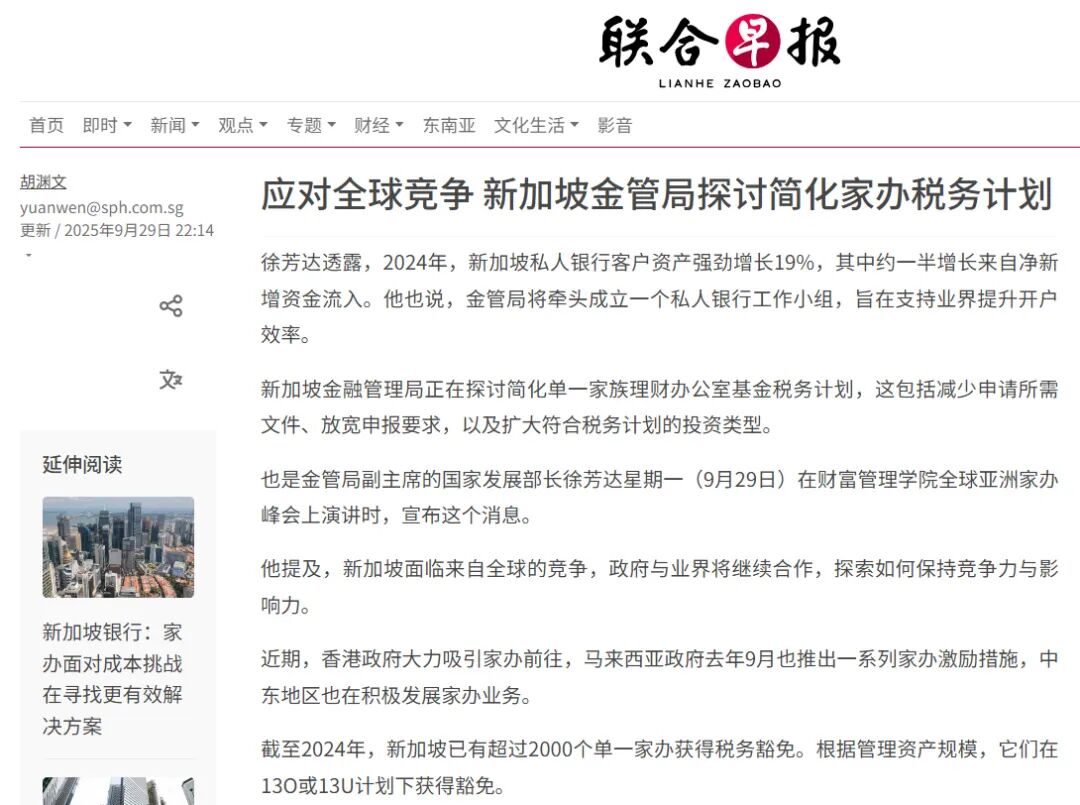
Photo credit: United Morning Post
To be successfully approved, the fund must meet a series ofrequirementsreflecting“substantial economic contribution“, thelatest core thresholds ofwhichare compared below:
To be successful in obtainingapproval fromthe Monetary Authority of Singapore (MAS), funds managed by family offices must meet a set ofcore requirementsdesigned to demonstrate“substantial economic contribution“to Singapore.These requirements vary depending on the tax incentive scheme chosen by the applicant, and are categorized intothe 13O(Onshore Funds) Schemeandthe 13U(Enhanced Funds) Scheme.
First, the most fundamental difference between the two programs is the minimum asset management size.
The requirement for the13Oscheme isS$20 million, while the13Uschemefor larger fundshas a threshold ofS$50 million.It is important to note that these funds must be invested in stocks, bonds and otherMAS-approved“designated investments“.
Second, in terms of local business spending, the two programs use the same grading requirements.
Forfunds withan AUM of less thanS$250 million, the annual local business operating expenses must not be less thanS$200,000per annum.The minimum expenditure requirement increases toS$500,000per annumwhen the size isS$250 millionor more. This requirement directly ensures that the family office generates real business for the local professional services industry in Singapore.
Third, regarding the allocation of professional investment teams, both plans mandate the hiring of professionals who are not family members.
The13Oplan requires the employment of at least2investment professionals, which can include up to1family member.The 13Uplan, which is larger and more demanding, requiresaminimum of3investment professionals, again including up to1family member.
Finally, in terms of promoting the development of the local capital market, both schemes set the samelocal investmentrequirements. Funds are required to invest at least10%of their net assets, orS$10 million, whichever is the lesser, directly in the local Singapore market, for example, by purchasing securities listed on the SGX or qualifying local private equity.
Overall,the13Oschemeprovides a standard pathwayforfamily funds withAUMof S$20 million or more, whilethe13Uschemesets the frameworkforlarger funds ofmore thanS$50 million.
Both use specific quantitative indicators to ensure that funds receiving tax incentives bring real expertise, employment opportunities and capital investment to Singapore.
Photo/MAS, Source: United Daily News
Step 4: Financial License Considerations
Typically, a single family office that manages assets solely for a single family can apply toMASfor an exemption from theCapital Markets Services (CMS) license, which greatly simplifies the compliance burden.
Note:The above information synthesizes the latest policies, and the specific implementation is subject tothe latestMASofficial interpretation.
Investment involves risks and financial management requires caution. For details, please contact a professional account manager to assess your situation and develop appropriate solutions.
Schematic diagram, source: United Daily News
[Conclusion]
In summary, Singapore’s attractiveness lies in the fact that it has built ahigh-quality, highly transparent and strongly regulatedecosystem. Ithas successfully screened and attracted global family capital seeking long-term sound growththrough clear policies (e.g.MAS‘s13O/13Uprogram), efficient governance (e.g.ACRA,MOM‘s standardized processes), and substantive business requirements.
Here, the preservation of wealth, the transmission of family values and the positive impact on society can be realized in synergy within a stable and credible framework.
*Reference sources: SingaporeMAS,ACRA,MOM,BOS, the United Morning Post, comprehensive news reports collated, reproduced with attribution, infringement and deletion of contact.
……
👇 Plus V enters Singapore’s largest outbound community 👇

Past Recommendations