
The early morning sun shines intothe office of CompanyA’s executives, where the approval letter they just received sits on the desk, and the phone is ringing off the hook for the branch’s project team, which just a few days ago was contemplating whether or not to disband the team.
December8,2025was a milestone for the executives of CompanyA,who had been overseas for ten years.On that day, they finally received theirL1Specialist Builders Licensefromthe Building Construction Authority (BCA) ofSingapore. This qualification, which allows them to undertake any ground support and stabilization works, means that they are able to undertake highly complex and specialized works in the Southeast Asian construction market, including foundation reinforcement and soil improvement.
Just a month ago, the executive had almost decided to suspend his Singapore branch plans, frustrated by the repeated rejection of his autonomous license application.“WithouttheL1license, we couldn’t recruit professional technicians, and the project simply couldn’t get off the ground,“he said as he recalled that difficult period,“We were faced with the choice of either succeeding in obtaining the license or abandoning the entire Southeast Asian market.“
1, out of the sea is blocked: ambitious Southeast Asia expansion program
CompanyAhas been working in the international market for ten years and has successfully conducted business in several countries. However, when the company’s executives set their sights on Southeast Asia and decided to set up a branch in Singapore and apply for a construction license, they encountered an unexpected dilemma.
The construction industry in Singapore is known for its high degree of rule of law, strict regulation and full openness. Under the Singapore Building Control Act, all builders engaged in the construction industry in Singapore are required toapply for the appropriate licensefrom the Building Construction Authority (BCA).
Singapore’s registration system for building and construction contractors is divided into a variety of categories, including the Building and Construction Related Category, the Core Building and Construction Category, the Mechanical and Electrical Engineering Category, and the Specialty Sub-categories. Under each category, there are different sub-categories and classes, forming a complex and rigorous system.
CompanyAexecutives initially hoped to obtain a professional engineering license through a self-application, but their submissions were repeatedly returned. They were overwhelmed by all the details required in the application process, especially for the qualification of a specialized type of work such as ground support and stabilization work.
Time went by, the branch was staffed and the office was rented, but due to the lack of necessary licenses, no substantive work could be carried out, not to mention the recruitment of local professional and technical staff, the morale of the whole team was low and the project was in danger of being stalled.
2、Professional breakthrough: a meeting to capture the core pain points
On the recommendation of a friend,CompanyAcontacted a professional consulting services team. The first meeting showed the fundamental difference in thinking between the two parties.
“The biggest problem encountered by many companies going overseas is that they do not systematically organize past contracts and determine the level of registration based on the amount of contracts in the classification before determining the specific category and level of application,“the head of the professional team pointed out at the conference. This is preciselythe crux of CompanyA’s application being rejected.
The building license application process in Singapore is extremely demanding, especially forprofessional engineering licenses likeL1.According to the regulations,there is a clear distinction betweena Professional Builder’s License (SB Licence) and a General Builder’s License(GB Licence).
During the application process, companies need to fulfill a number of conditions including financial strength, business contract records, and technician qualifications, and submit corporate information and relevant supporting materials through the system.
In addition,CompanyAwill need to address a number of compliance requirements, includingcompleting company registrationwith the Accounting and Corporate Regulatory Authority of Singapore (ACRA) and may need to obtainbizSAFEsafety certification, a national program run by the Singapore Workplace Safety and Health Council.
The consulting service team analyzed the construction industry regulatory system in Singapore, as well asthe BCA-led contractor registration system and licensing system, and helpedthe senior management of CompanyAto understand the root cause of their application failure: lack of in-depth understanding of local regulations, and the application materials did not adequately reflect the company’s strength and professionalism.
3. Overcoming difficulties: the account manager’s“never give up“philosophy
Upon taking over CompanyA’s application project, the Account Manager immediately started a comprehensive work. She carefully examinedall the requirements ofBCASingaporeforthe L1license, including the qualification requirements for the technical manager, paid-up capital criteria, andthe conditions for the appointment ofthe Approved Person (AP).
According to the Building and Construction Authority of Singapore (BCA),technical managersapplying forthe L1Specific Builder’s License are required to have an undergraduate or postgraduate degree in civil or structural engineering from a college or institution recognized by the authority, and have at least5years of hands-on experience in building constructionafter obtaining the degree.The Account Manager helpedCompanyAtoidentify and validate the technicians who meet the requirements.
The biggest challenge in the application process comes from the preparation and submission of materials. The Account Managerworked closelywiththe CompanyAteam to organize the application materials several times and sort out the entire process. Building license applications in Singapore are usually made through ZF’sGoBusinessplatform, which requires all materials to conform to a specific format and standard.
After the first complete submission,BCA‘s review comments raised several key issues: the qualification certificates for some of the technicians were not sufficiently complete, the supporting documentation for the company’s past engineering experience lacked relevance, and the financial information was not organized in a way that met local requirements.
In the face of such feedback, the Account Manager was not discouraged but led the team to reorganize the materials and addressthe issues raised byBCAone by one.She delved into the regulatory details of Singapore’s construction industry and even made reference to the requirements of the Green & Elegant Builders Scheme to ensure that the application materials not only met the basic requirements, but also reflectedCompanyA‘s comprehensive strengths.
The account manager maintained a consistent communication principle in her service, viewing each time she was returned as an opportunity for improvement. When the application was called back a second time, she instead saw hope:“This time,BCAasked more specific questions, indicating that they had carefully reviewed our materials, which was a positive sign.“
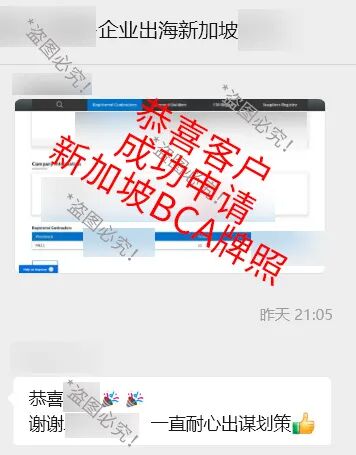
Picture / Screenshot of customer’s favorable comments, theft of pictures will be punished!
4. Teamwork: from media diversion to perfect closure
CompanyA’s success was no accident, but a prime example of professional teamwork. It all started with a professional article written by the team about the opportunities in the Singapore construction market, which accurately captured the pain points of the offshore companies and attractedthe attention of CompanyA’sexecutives.
In-house, a critical team meeting changedCompanyA’s fate. The team not only accurately analyzed the regulatory environment of Singapore’s construction market, but also pinpointedCompanyA‘s core pain point, the lack of a localized application strategy and in-depth understanding of regulations.
During the documentation stage, the team carefully checkedthe technical strength of CompanyAto ensure that all technicians metBCA‘s stringent standards. For theL1license application, the technicians need to have a civil or structural engineering related degree and at least5years of hands-on experience in the specialized field.
The Account Manager’s“never give up“spirit was evident throughout the application process. She has an in-depth understanding of the Singapore building license application process and knows how to deal withBCA‘s various auditing requirements. When the application was rejected for the third time, she still maintained her professional attitude, calmly analyzed the problem and reorganized the materials.
“Having an application knocked back doesn’t mean failure, it’s theBCAtelling us what we need to improve,“she said as she shared her experience with the team,“It’s all about how we interpret that feedback and adjust accordingly.“
This professional attitude and persistence eventually formed a perfect closed loop of work: from the precise attraction of new media articles, to the team meeting to seize the pain points of customers, to the continuous follow-up and professional service of account managers, each link reflects the professional ability and service concept of the team.
5. Moment of Triumph:Dawn of Victory onDecember8,2025
On December8,2025,CompanyA’s executive received the long-awaited email notification.He was thrilled beyond wordswhen he clicked on the email and saw theL1license approval letterfromthe Building and Construction Authority (BCA) ofSingapore.
From thefirst submission of documents onOctober22ndto thesuccessful approval onDecember8th, after many communications and patience in adding additional information, it was finally approved!
The acquisition of this license means thatCompanyAcan officially start its ground support and stabilization engineering business in Singapore, which is a key step in developing the Southeast Asian market.
According to Singapore regulations, thisL1license is valid for3years andqualifies CompanyAto undertake all types of foundation strengthening, soil improvement and other highly complex specialized works. This is exactly the key qualification they need to explore the Singapore market.
The news of the license approval spread quickly throughoutCompanyA’s Singapore branch. Team members have expressed that this is not only the acquisition of a license, but also the best reward for their perseverance and hard work. The team, which once considered disbanding, is now full of new energy and motivation.
CompanyAexecutives contacted the account manager first after receiving the approval letter,“Without your professional help and perseverance, we could not have obtained this license. Your services have changed our destiny in the Southeast Asian market.“
The Account Manager’s professional attitude and persistence enabled her to never give up in the face of challenges. It was this attitude that ultimately helpedCompanyAovercome the final hurdle of the license application.
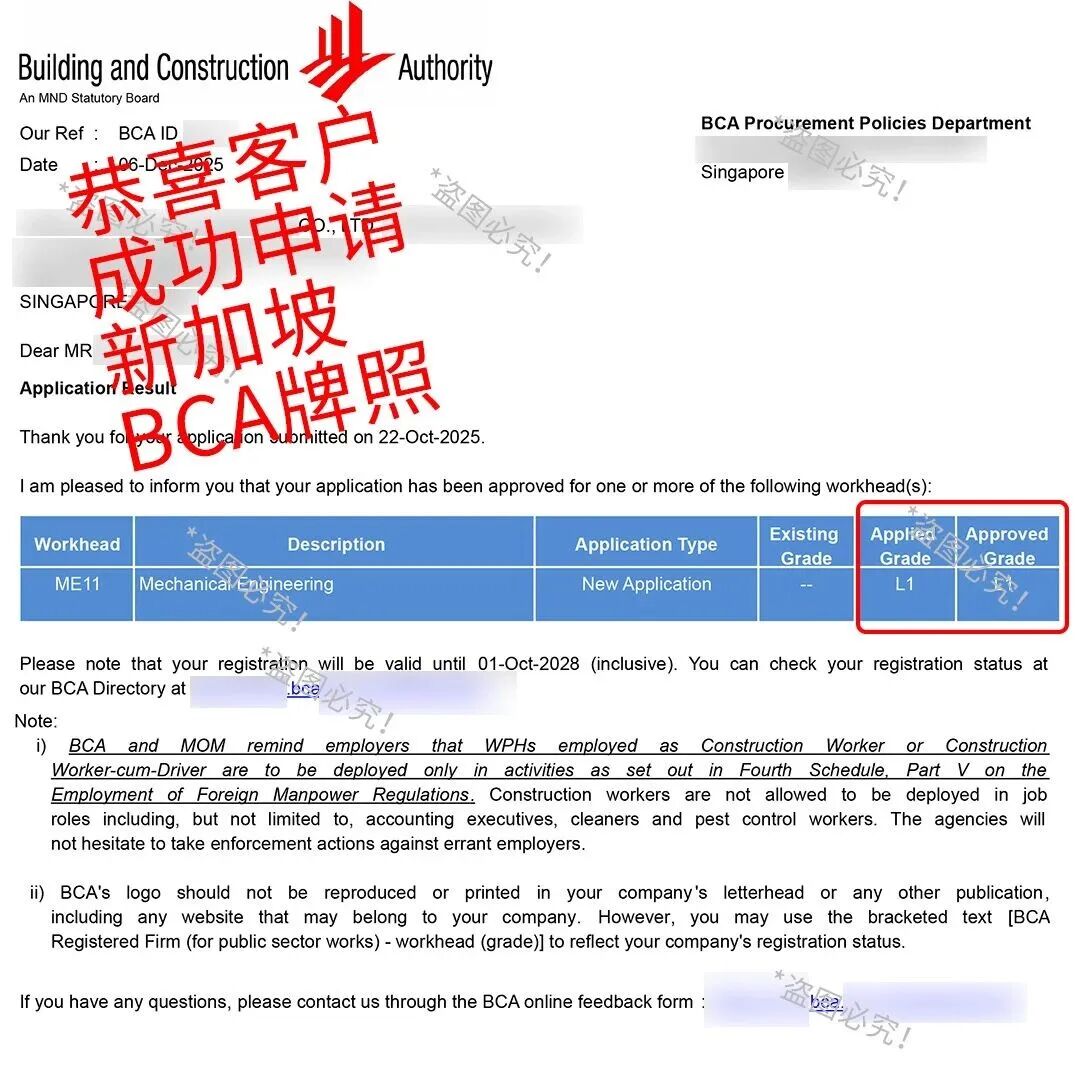
Photo/Customer’s successful application for BCA license, stolen image must be punished!
6. Lessonslearned: the key to applying for a building license in Singapore
CompanyA‘s success story provides valuable experience for companies planning to enter the Singapore construction market. According to Singapore’s construction industry regulatory policy, companies going overseas must strictly comply with the laws and regulations of the regulatory body and prioritize compliance over all business activities.
For construction companies, it is important to understand Singapore’s contractor registration system. This system is a prerequisite for bidding for public sector projects, and the registration categories are divided into Building Works Related, Core Building Works, Mechanical and Electrical Works, and Specialty Sub-categories.
Before applying for a license, companies should sort out past contracts and determine the level of registration based on the contract amount of the classification. If they are unable to register for a higher class due to lack of pre-certification, they may consider applying for the next level of certification first, while making up for the pre-certification, and then upgrading subsequently.
Seeking to establish partnerships with good local companies, as well as the orderly localization of management and technical teams, are all important factors for companies to succeed in the Singapore market. Specialized work should be left to the professionals, especially when dealing with a highly regulated market like Singapore.
Determining whether the local technician’s qualifications are met and whether he or she isregisteredwithCRSare also critical steps inthe application process.These details often determine the success or failure of the application.
[Conclusion]
Now thatthe Singapore branch of CompanyAhas started its official operation, the team is busy with the preparation of the first project. TheL1license is quietly hanging in the most prominent place in the office, and whenever a client visits, the branch manager will proudly introduce the story behind this license.
Outside the windows of the office building, Singapore’s construction sites are scattered all over the city, and countless cranes outline the city’s future in the skyline.a isready to write its own chapter of Southeast Asia in this hot land.
…
👇 Plus V enters Singapore’s largest outbound community 👇

Past Recommendations